
Dr. Elizabeth Olson: 2024 William & Sara McCoy Performing Arts Leadership Award Recipient

Cécile McLorin Salvant’s December 7, 2024 performance at Memorial Hall.
Honoring the Legacy of William and Sara McCoy: A Dedication to Arts Leadership and Education
The William & Sara McCoy Performing Arts Leadership Award celebrates the enduring legacy of William (Bill) and Sara McCoy, whose leadership, vision, and generosity have had a profound impact on Carolina Performing Arts at UNC-Chapel Hill. Bill McCoy, former Vice Chancellor of Finance for the UNC System and Interim Chancellor at UNC-Chapel Hill, helped shape the university’s strategic direction, while Sara McCoy’s steadfast dedication to the arts, through her involvement on nine campus boards and committees, amplified the cultural richness of the Carolina community.
This prestigious award honors the McCoys’ commitment to the intersection of education, research, and the performing arts. Each year, the McCoy Award recognizes a UNC-Chapel Hill employee who, like the McCoys, embodies the values of artistic excellence, educational innovation, and community engagement.
Meet the Inaugural McCoy Award Winner: Dr. Elizabeth Olson

The inaugural recipient of the William & Sara McCoy Performing Arts Leadership Award, Dr. Elizabeth Olson, is a professor of Geography and the Environment and Global Studies at UNC-Chapel Hill. Dr. Olson’s groundbreaking work in integrating the arts with education and social impact sets her apart as a true visionary in both the academic and artistic community.
Through her collaboration with Carolina Performing Arts and resident artist Culture Mill, Dr. Olson has redefined the role of art in academic engagement, creating a new framework for interdisciplinary collaboration that bridges the worlds of art, geography, and social justice.
Transforming Education Through Art and Geography
Dr. Olson’s work challenges traditional boundaries by combining geography with the arts, creating innovative ways to understand landscapes, histories, and cultural narratives. She is passionate about using art as a tool for social change and community healing, especially in partnership with local artists and organizations. Reflecting on her work, Dr. Olson asks, “How can art and geography combine to invite new understandings of our everyday landscapes? How might this fusion empower us to address the urgent, ongoing needs for justice, care, and repair?”
Her interdisciplinary approach has inspired countless students, artists, and community members to engage with their surroundings in profound, meaningful ways.
“As a geographer deeply committed to building and teaching transformative scholarship through collaboration, Carolina Performing Arts offers the substrate for cultivating relationships that make our imagined practices materialize,” she says.
By fusing arts education with geography, Dr. Olson fosters transformative learning experiences that encourage students to critically examine the world around them and their roles in shaping its future.
A Collaborative Process of Discovery
Dr. Olson’s partnership with Carolina Performing Arts and Culture Mill has brought together a diverse group of artists, scholars, and community members to create impactful, interdisciplinary projects. “With Carolina Performing Arts’ support, we had the time and resources to forge an ongoing partnership with Culture Mill, local artists, The Marian Cheek Jackson Center, and Carolina students,” she says. These collaborations have allowed students to engage directly with artists, bridging the gap between academic learning and real-world social issues.
In their first collaborative project, Well, Dr. Olson’s social geography students worked alongside artists through Carolina Performing Arts at Southern Futures to support the Jackson Center’s oral history archiving project.
“While supporting the Jackson Center’s oral history archiving process, we brought the voices of generations of the town’s Black builders to the center of campus through a sound and movement intervention,” she says.
Dr. Olson further acknowledges the vital role Carolina Performing Arts played. “From hosting a website to help us disseminate the project, to providing space and equipment, to directly supporting artists for their work, Carolina Performing Arts made the project possible,” she says.
This arts-based co-teaching model exemplifies the transformative potential of collaboration, where academic learning is brought to life through the contributions of local artists and community partners.
A Vision for the Future of Arts Education and Social Impact
As Dr. Olson looks ahead, she is filled with gratitude for the continued opportunity to collaborate and create.
“I am constantly reflecting on my gratitude to have the space to dream with others. Carolina Performing Arts continues to be a powerful partner in making these interdisciplinary and community-centered projects possible,” she says.
“It is truly an honor to receive [the William & Sara McCoy Performing Arts Leadership Award] from an organization that has already given me so much,” she adds.
Dr. Olson’s work exemplifies how integrating arts education and community engagement can create a more just, compassionate, and thoughtful world. Through her continued efforts, she exemplifies the legacy of leadership, generosity, and passion for the arts that the McCoys embodied.
Join Us in Celebrating Dr. Olson’s Achievement
We invite you to join us in congratulating Dr. Olson on receiving the William & Sara McCoy Performing Arts Leadership Award. Her work serves as a beacon for the future of interdisciplinary arts education, where academic inquiry and social impact intersect to drive meaningful change.
The Power of Giving: Stories Behind Carolina Performing Arts’ Success
By Lauren Wingenroth
Rachel Baum can’t exactly remember what was on the program the first time she attended a Carolina Performing Arts show as an undergraduate at the University of North Carolina at Chapel Hill over a decade ago. It may have been the acclaimed banjo player Béla Fleck, or possibly Alvin Ailey American Dance Theater. What she is sure of: After that night, she was hooked.
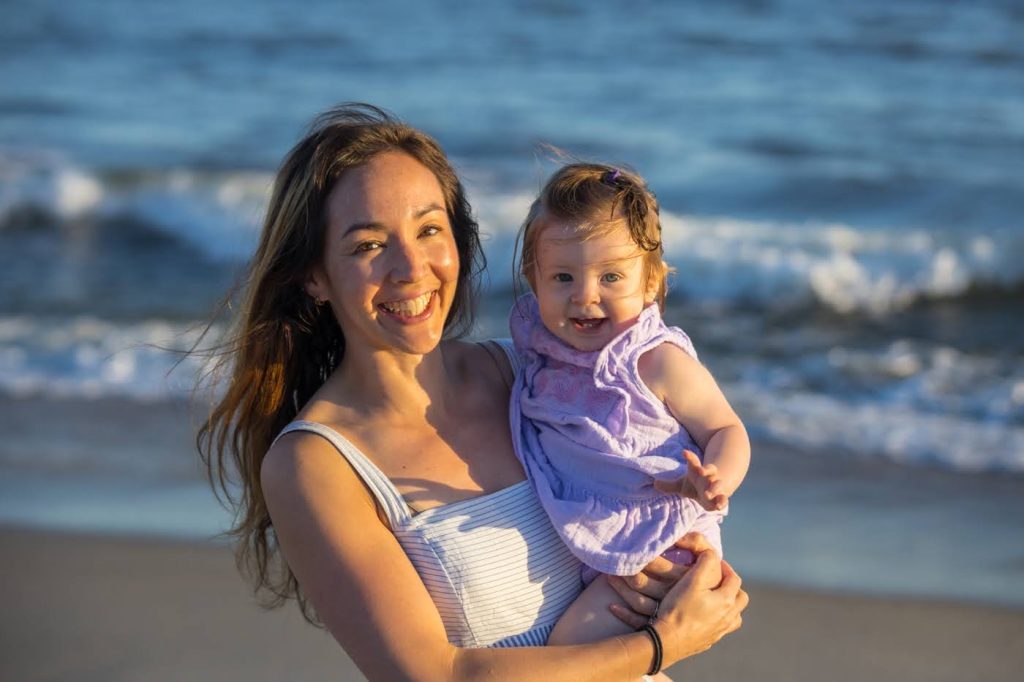
Baum spent the rest of her undergraduate career attending as many shows as she could, and when she stuck around to earn her PhD in Environmental Sciences and Engineering, she brought her grad school friends to Memorial Hall, too. “It was so fun to bring people in and see them get excited about it, especially their first time,” she says. “They’d be like, ‘I can’t believe this is so accessible to me as a student.’”
After a detour to the Bay Area for several years (she credits CPA with her interest in seeking out out-of-the-box performances while in San Francisco), Baum’s life recently came full-circle: She’s back in Chapel Hill, working at UNC’s Institute for Risk Management and Insurance Innovation, and continuing to see as many CPA shows as she can—but this time, as a donor.
For Baum, giving to CPA is about recognizing the impact that those performances—which were made possible by CPA’s $11 student ticket program—had on her life, and wanting all students to be able to have those same transformative experiences with the performing arts.
“I want students to be able to take advantage of this, and to help them blossom,” she says. “I want every single student to know about these tickets. If you just try it once, you’ll get hooked. And you’ll be like, ‘I need to go to every single one of these.’”
CPA celebrates its 20th anniversary this season, and throughout those past twenty years, donors like Baum—each with their own distinct relationship to the arts and reason for giving—have shaped the organization into what it is today, and helped secure its future for the twenty years to come.
“Every single time I see a show, there’s always something I get out of it,” says Baum. “As a donor, you’re opening that opportunity up to somebody, or you’re bringing a new performer into the light. You’re really opening up people’s perspectives, which I think is needed now more than ever.”
CPA “Continues to Feed My Soul”
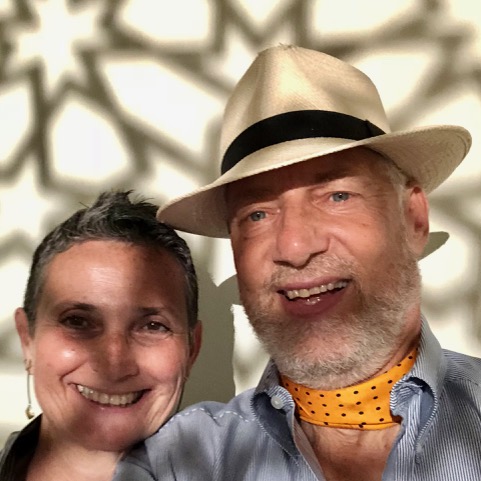
Having grown up watching avant garde performances in New York City’s Greenwich Village, David Roth prides himself on his penchant for boundary-pushing contemporary performing arts. That’s part of why Roth and his wife, Adele, created CPA’s Creative Collisions for Artistic Innovation Endowment, aimed at “giving a platform for diverse views, opinions and expressions, so that people can deeply appreciate the multitude of ways in which human beings can express their desire for common ends,” he says.
The first performance supported by the Endowment took place in October: Martha Redbone Roots Project and American Patchwork Quartet in This Land is Our Land, a stirring, soulful evening of music with eclectic influences from folk to gospel to jazz to West African. “She was just glorious,” says Roth of Redbone.
Supporting CPA has allowed Roth to see firsthand just how powerful the performing arts can be, both on a personal and community level. “What I’ve gotten from giving to CPA is the reward of knowing that the organization continues to feed my soul, and feed my heart, and feed the community,” he says. “When I see audiences let go of whatever defense they have and give themselves over to something, I think those moments are of extreme value, and contribute to creating a world of loving kindness and awareness.”
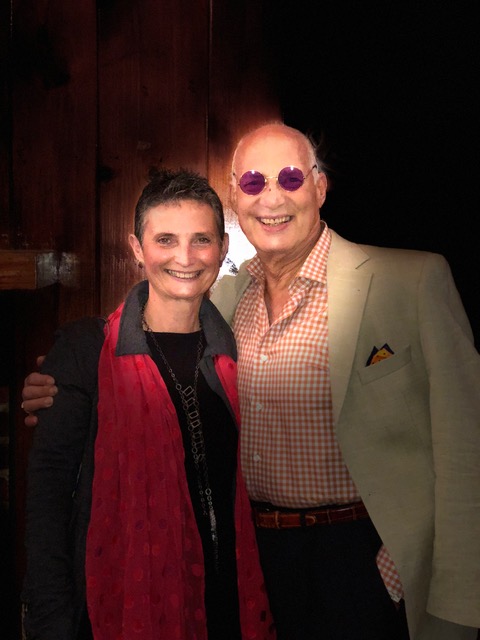

Julie Daniels, an alum who recently moved back to Chapel Hill and joined CPA’s board, agrees. “There’s nothing like sitting in a dark theater with a community of people and experiencing the same thing together,” she says. “It brings people together, and we need that now more than ever.”
A Sense of Belonging

Anyone can tap into the community atmosphere one often feels at a CPA performance. But those who are involved in the organization—whether through monthly or annual giving, or board service—often feel a deeper sense of belonging, which makes those performances all the more fulfilling.
“I know the behind-the-scenes,” says Jerri Bland, a CPA board member and founder of the Dr. Jerri Bland Fund for Student Access. “When you’re in the seat watching things you heard about six months ago, it’s a different feeling.”
It’s also special to chat with fellow patrons, and hear their perspective on CPA performances, says Bland. “You’re like, ‘I’m a part of that. I’m a part of helping to make this happen.’”
Ken Broun, who with his wife Margie has supported CPA since its founding, agrees. “You feel a sense of belonging,” he says. “Of, ‘this is our organization.’ It enhances the experience.”
The Brouns feel so connected to CPA that several years ago they moved to downtown Chapel Hill, partially to be closer to Memorial Hall. (Ken jokes that “as we get older, we feel that they’re moving it further away every year.”)
After twenty years of patronizing CPA and even longer supporting the arts in Chapel Hill, they appreciate that Memorial Hall is often full of friends and familiar faces.
But they also “find it delightful when we notice a whole different mix of audiences,” says Margie. “Sometimes when we know less people, we enjoy it—I enjoy seeing the different groups that different performances attract, and how even the type of dress people wear depends on the performance. It’s fun to see the diversity. I really like that CPA has widened so that there are different performances that appeal to people other than people like us.”
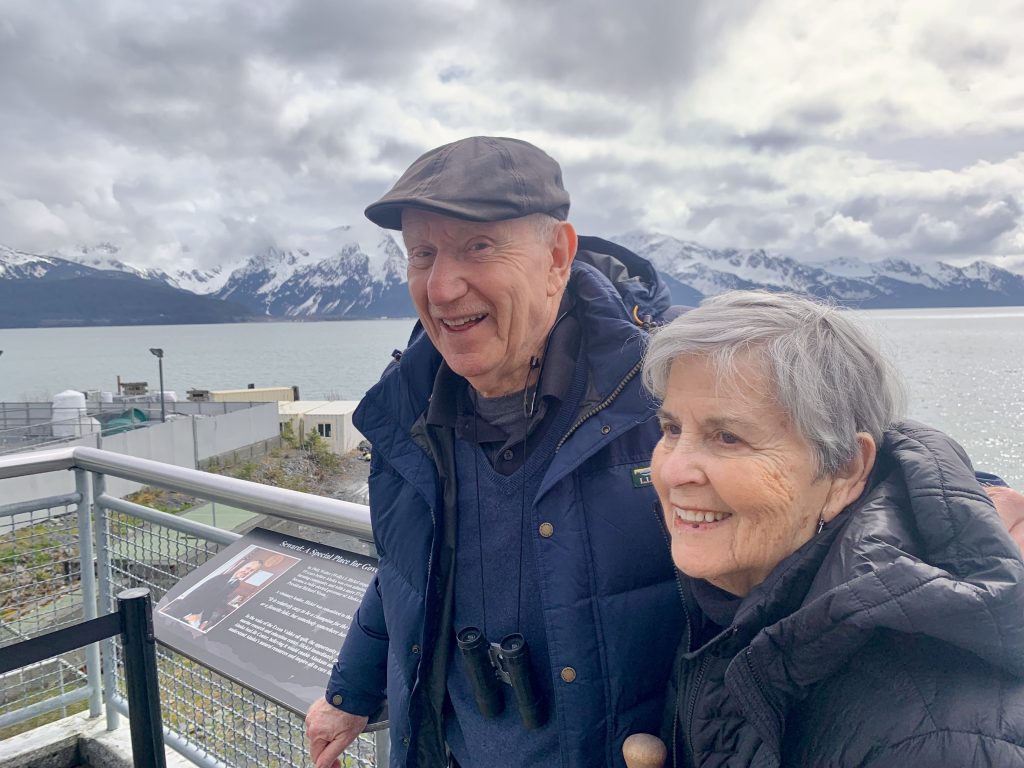
For the Roths, CPA helped them find belonging in Chapel Hill. “We moved here in 1997 from New York, and it took us a while to acclimate to the community,” he says. “A turning point was in 2004,” when CPA was founded. “Everything just seemed to align—something clicked for us,” he says.
Opening Doors to the Arts
The fact that finding that sense of belonging at CPA isn’t conditioned upon being a certain demographic, or having a certain taste in the performing arts, is at least partially made possible by the diverse breadth of CPA’s programming. But it’s also a product of CPA’s relative affordability, including the $11 tickets that are available to UNC students as well as local students of all kinds.
Those $11 tickets are supported by donors like Bland. “As an alum, I’m interested in making sure that the doors of CPA are open for everyone,” she says of her Fund for Student Access. “I want students to have the opportunity to see world class theater and world class music. I don’t want money to be a barrier for anyone; that’s why I created the Fund. It will be after I’m gone that students really have access to it, but I want to make sure that ability never goes away.”

It’s not just getting students in the doors of Memorial Hall that donors like Bland enable, but making connections from the stage back to the classroom. “I think that’s an important thing for us as board members to think about,” she says. “We are art lovers, yes, but our need to go to performances is secondary to our need to educate about the arts. It’s easy to get wrapped up in, ‘Alvin Ailey is coming!,’ but we should think about what the impact is to the academics. How do we get the University as a whole engaged in this art?”
“I think that bringing high-quality art to this community enhances the attractiveness of the University overall,” says Ken. “And encouraging students to partake in it increases the educational experience.” He remembers observing a master class for UNC students taught by a musician from an orchestra in town with CPA. “I thought it was remarkable,” he says.
Daniels agrees, and believes that making connections between academics and the arts, “creates a well-rounded student,” she says. “We want people who are critical thinkers and who are exposed to a lot of different things, and the arts are a great way to do that. It’s a safe space; it’s a way for people to examine complex topics in a meaningful way with other people. It exposes students to something that will be a part of their life for the rest of their life.”
“Opportunities like these really solidify your relationship to the arts,” says Baum. “They’re a bridge to somewhere. I love it for students, because they’re young. Their minds are malleable, and they’re exploring things—it’s really powerful for them.”
Donors and board members have had their own artistic doors opened by CPA’s programming. For instance, the Brouns discovered Samara Joy, who has since become one of their favorite singers, and Daniels realized her love for dance after attending Hong Kong Ballet’s Romeo + Juliet last year. “I’ve started going to Carolina Ballet—I’m seeking out dance performances,” she says. “I told my daughter who lives in New York that I want to go to American Ballet Theater. Dance is really phenomenal, I just wasn’t exposed to it much.”
For Baum, seeing something new at CPA, “feels like a dopamine hit to your brain,” she says. “There’s this novelty, this excitement, that really grabs you.” One young potential patron she’s particularly interested in exposing to the arts? Her infant daughter (who has already attended one CPA event!). “I want her to grow up seeing the arts and being engrossed in them,” Baum says.
“I’m Hoping to Share it With As Many People As I Know”
Bland sees serving on CPA’s board as a chance to shape the organization’s future for generations of audiences to come. “It’s a huge opportunity to not only benefit personally from supporting the arts, but to share that love with other people,” she says. “Giving CPA—the staff, the student volunteers—that support, and letting them know we’re here and available to give feedback. We can shape what this organization looks like. In five or ten years, the things we’re doing today are going to be taking fruition and having an impact on what students and audiences are experiencing. It’s an opportunity to have a voice in what’s happening in our community.”
Of course, financial gifts are also key to sustaining CPA programming—and anyone can contribute. “All contributions are important, at any level,” says Daniels. “You can contribute what you can afford—everything makes a difference, and that support is something CPA counts on. If we want to see this level of programming continue, we have to be willing to make those donations so the organization can thrive.”
“There are so many ways to contribute value,” says Roth. “One is financially. Another is to participate in some way; to make your voice heard. Nothing’s too small.”
Roth recognizes that while he has a taste for new, groundbreaking performances, others in his demographic feel more comfortable with the familiar. And while there’s nothing wrong with that, Roth sees an opportunity to “be a liaison, as a senior, between CPA and that community,” he says. “I’m committed to supporting how CPA is approaching their future with the hope that they can bridge that gap and encourage people to go along for the ride, take the risk, and enjoy the risk.”
In this way, supporting CPA doesn’t have to look like giving money or even time or resources—it can be about ambassadorship, and advocacy. “I’m really excited to let more people know about CPA,” says Daniels. “That’s one of the things I can do, expose people who may not know about it to how great it is, get them to come to a show. Because if they come, they’ll come back. I’m hoping to share it with as many people as I know in the community.”
Breaking Bread: Recipes That Celebrate Culture, Connection, and Community

Few things embody the spirit of togetherness quite like the act of breaking bread—a timeless gesture of connection, warmth, and shared experience.
Much like art, the act of sharing a meal can create space for storytelling and connection that bridges cultures and deepens bonds.
With that, we’re excited to share a collection of cherished bread recipes from the artists of the Silkroad Ensemble. These recipes offer a taste of their cultural traditions and celebrate the universal language of art and shared meals.
As you gather with loved ones this season, we invite you to try these special bread recipes. Whether you’re baking with family, sharing with friends, or connecting with neighbors, we hope these recipes bring a bit of warmth and connection to your table.
Let’s break bread together and celebrate the art of coming together, one bite at a time.
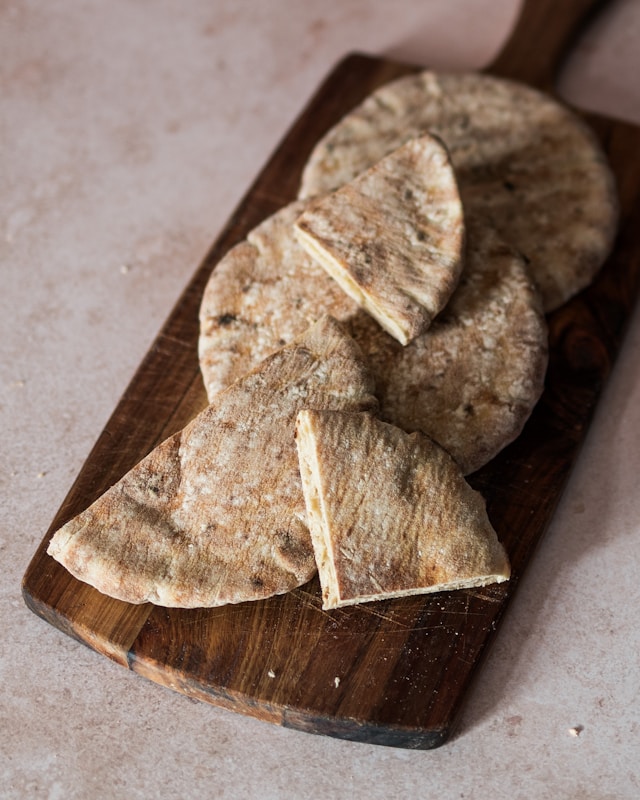
Lebanese Pita Bread
Shared by Layale Chaker
Artist Notes:
Optional Tips
- If you want a softer crust, brush the top with olive oil after baking.
- The Greek yogurt adds a subtle tang and extra moisture, resulting in a tender, soft crumb. But you can go entirely without it, just substitute it with a cup of warm water!
- Enjoy your homemade bread!
Ingredients:
- ¾ cup warm water (110°F or 43°C)
- 1 package active dry yeast (2¼ teaspoons)
- 1 teaspoon sugar (for activating yeast)
- 3¾ cups bread flour (469 grams), plus extra for dusting
- 1½ teaspoons sea salt
- 1 tablespoon sugar
- 3 tablespoons extra-virgin olive oil, plus more for greasing the bowl
- ¾ cup whole-milk Greek yogurt (optional)
Instructions:
Activate the Yeast: In a small bowl, mix the warm water, yeast, and 1 teaspoon of sugar. Let it sit for 5-10 minutes, or until it becomes foamy. This step confirms that the yeast is active.
Prepare the Dough: In a large mixing bowl, combine the bread flour, salt, and 1 tablespoon of sugar. Make a well in the center and pour in the activated yeast mixture, olive oil, and Greek yogurt (if using). Stir until the ingredients start to come together and form a sticky dough.
Knead the Dough: Turn the dough out onto a floured surface. Knead it for about 8-10 minutes, or until it becomes smooth and elastic. If the dough is too sticky, sprinkle a little extra flour as needed. The Greek yogurt will make the dough softer and slightly more moist, so adjust with flour if needed.
First Rise: Lightly oil a large, clean bowl and place the dough in it. Cover the bowl with a damp cloth or plastic wrap, and let it rise in a warm, draft-free area for about 1 to 1½ hours, or until it has doubled in size.
Shape the Dough: Once the dough has risen, punch it down to release any air. Transfer it to a floured surface and shape it into a round loaf or divide it for smaller rolls.
Second Rise: Place the shaped dough onto a lightly floured or parchment-lined baking sheet. Cover it loosely with a cloth and let it rise for another 30-45 minutes, or until it’s puffed up.
Bake: Preheat the oven to 375°F (190°C). Bake the loaf for 25-30 minutes, or until the bread is golden brown and sounds hollow when tapped on the bottom. If making rolls, bake for 18-22 minutes.
Cool and Serve: Let the bread cool on a wire rack for at least 10 minutes before slicing.

Hidalgo County Homemade Tortillas
Shared by Edward Perez
Artist Notes:
“Where I grew up, no one would ever eat a tortilla made in a factory. Tortillas were not something that accompanied the rest of the food, they themselves were the main attraction, and my family would sit around the table for long stretches of time on weekend mornings eating more tortillas after we had finished our breakfast plates. Everyone who made tortillas had their own touch and everyone’s tortillas came out just a bit different. My grandmothers were my favorites, and flour tortillas were the first food that I ever learned to prepare. “
Ingredients:
- 4 cups flour
- 1 cup Crisco vegetable shortening (or just a hair less)
- Plenty of salt to taste
- Optional: a tiny pinch of baking powder
- Water as needed
Instructions:
Step 1: Prepare the dough:
- In a large mixing bowl add the flour.
- The Crisco will be sticky, break it into small globs and add it to the bowl, sifting as necessary so that it distributes well.
- Add a generous amount of salt to taste
- Optional (most people prefer the results without): add a small pinch of baking powder
- Pour in a small amount of water to one corner of the bowl and use your hands to clump the flour mix in the immediate vicinity into a little ball of dough. Pull it out and knead it until it has a relatively even consistency.
- Add just a little bit more water into the bowl and put your dough ball back in the spot where it landed, rolling it around and sticking some more of the freshly wet flour mix onto your ball of dough to increase its size. Knead it again until it has an even consistency.
- Repeat the last step as needed until all the flour mix is in one ball of dough. Try to use as little water as possible along the way, always adding more flour to the dough ball if the dough ball seems ready to accept it.
- Once the large ball of dough has a smooth, even consistency, put It back in the bowl, cover with a towel and let it sit for at least ten minutes. Or, as my grandmother told me, “Let him rest.”
Step 2: Roll the tortillas
- After at least ten minutes, remove the towel and take out a large cutting board (preferably wooden) and a rolling pin
- Pinch off a little bit of dough from the large ball and roll into a small sphere between your palms.
- Place the small dough ball on the cutting board and roll it out with the rolling pin. Roll from the center out, first up then down, then flip the dough over to the other side, rotating 90 degrees in the process, and repeat. If you find that the dough is too sticky, you may choose to add just a little bit of loose flour to the rolling pin, the cutting board, or both. You will find as you begin to roll that the dough naturally wants to contract back to its old position. Once you have rolled it thin/flat enough, it will maintain its shape and that’s how you know you have finished. Rolling perfectly round tortillas takes a lot of practice and depends largely on how consistent you were able to make the ball of dough. Don’t worry if your tortillas come out in funny shapes, they will still taste good.
- Place finished raw tortillas in a stack as you finish each one. Optionally place a tiny bit of flour between each one if they seem to be sticking too much.
- Once you finish rolling the stack of tortillas, they can be kept in this state in the fridge (covered with plastic wrap to prevent drying out) for several days. Do not continue to the step of heating the tortillas until you are going to eat them. In my family, our usual practice was to roll a whole batch and then only heat a small number of them for each meal.
Step 3: Heat the tortillas
- Preheat a comal (heavy cast iron flat griddle) over medium-high burner. Apply a little bit of Crisco to a paper towel and quickly and carefully spread it on the comal to lubricate. If you don’t have a comal, you can try using a non-stick skillet but it’s not quite the same.
- Usually medium-sized tortillas can fit three at a time on the comal. Place three tortillas on the comal. At first, they will stick but after a few seconds, you will be able to slide them around. As soon as they are not sticking, flip them the first time.
- Wait until they are finished on the other side, with a nice white color and a few light –colored burn spots, and then flip them the second time.
- They may inflate after the second flip and this is totally fine (it’s a sign they are cooking on the inside) feel free to press them back down with a spatula or deflate them. Remove them when they are are finished cooking on the other side and repeat, adding three more tortillas until you have heated all of the tortillas that you plan to immediately eat.
- Place finished tortillas on a plate under a towel to keep them warm.
- Put the stack of any remaining unheated raw tortillas in the fridge on a plate covered in plastic wrap
- Never clean the comal with water or soap.
Serving suggestions
Feel free to put a little butter and salt on them. They taste great alone, with coffee, or with scrambled egg in them as breakfast tacos. Even better with egg that has Mexican chorizo scrambled into it.
Tortillas taste far better if eaten in the first thirty seconds to one minute after they come off the comal. Sometimes my family would heat up tortillas for breakfast in two rounds so that we were never eating tortillas that had been sitting around for too long.

Rhiannon Giddens’ Biscuit Recipe (Abridged)
adapted from Southern Living
Shared by Rhiannon Giddens
Ingredients:
- 1 stick unsalted butter – frozen overnight
- 2 1/2 C self-rising flour
- 1 C chilled buttermilk
- parchment paper
- melted butter (2 T)
- pan just big enough for the biscuits you are making
Instructions:
- Measure a piece of parchment paper to fit your pan; make sure to make it longer but exactly as wide, so you can use the overhang to lift the sheet when there’s biscuits on top. Set aside.
- Sift the flour into a bowl and then grate in the frozen butter. Toss together briefly (but no need to work the butter into the dough). Throw this into the freezer.
- While the bowl is in the freezer, preheat the oven to 475 degrees F.
- Make a well in the middle of the butter/flour mixture and pour in the buttermilk.
- Stir until it starts to come together, it should be pretty sticky and a bit wet.
- Turn it out onto a well-floured surface and pat into a rectangle.
- Fold the dough like a letter and flatten out; turn and do it again in the other direction; do that whole process at least once more, for a total of 4 sets of folds.
- Roll or pat out and start cutting your biscuits; use a biscuit cutter or a glass with a sharp edge top to cut them out, being careful NOT to twist (that is a myth that will end up actually curtailing your biscuit’s rise).
- Place the biscuits on the parchment paper, in a honeycomb pattern so that there are no spaces. Move the biscuit laden parchment with the overhang onto the pan; this will take practice.
- Bake at 475 for 12-15 minutes until lightly browned. You can feel they are done by shaking one with your fingertip on top; if they are too movable, they aren’t quite set. Throw them into a basket lined with a tea towel and cover; they will stay nice and moist this way.
Learn more about biscuits from Rhiannon and the best chefs in Durham at Biscuits and Banjos – April 25-27, 2025 in Durham, NC. www.biscuitsandbanjos.com

Sandesh
Shared by Sandeep Das
Artist Notes:
This sweet dish is offered to Gods and Goddesses for every ritual and is a favorite for all festivals like Diwali , Holi, etc. A specialty from Bengal! Love, Sandeep
Ingredients:
- One can of whole milk ricotta cheese
- One small can of sweetened condensed milk
- Optional: cardamom powder and saffron strands
Instructions
- Put the whole can of cheese in a flat pan on a slow to medium high cooktop.
- Keep stirring so it doesn’t stick at the bottom for around 20 minutes then add condensed milk.
- Keep stirring for around 45 minutes, it will start to bubble and thicken.
- Add cardamom powder and saffron strands (optional).
- Once it becomes semi solid, take it off of the stove.
- After it’s cooled, make small balls of it in the shape of Sandesh.
- Serve and enjoy!

Cream Scones
Shared by Maeve Gilchrist
Artist Notes:
- Preheating the baking tray is essential for high-rising scones
- Makes 6 scones
Ingredients:
- 1½ cups (200 g) all-purpose flour
- 1 tablespoon baking powder
- i teaspoons salt
- ¼ cup (50 g) superfine sugar
- 1 cup (240 ml) heavy cream
Instructions:
- Preheat the oven to 425°F (220°C). Lightly flour a baking tray and place in the oven to preheat.
- Sift the flour, baking powder, and salt together in a medium bowl.
- Add the sugar and ¾ cup of the cream; work the dough with a fork until you have even-size clumps. If the mix is too dry to hold together, add the remaining ¼ cup cream and mix thoroughly.
- Place the dough on a floured worktop and knead 4 or 5 times. Dust with flour and roll flat with a rolling pin until i½ to 2 inches thick. Cut out 2½- to 3-inch circles with a crimped scone cutter.
- Place scones on the preheated tray, and bake for 6 to 8 minutes, until they have risen nicely and browned at the edges.
- Serve with jam and butter. Best right out of the oven!
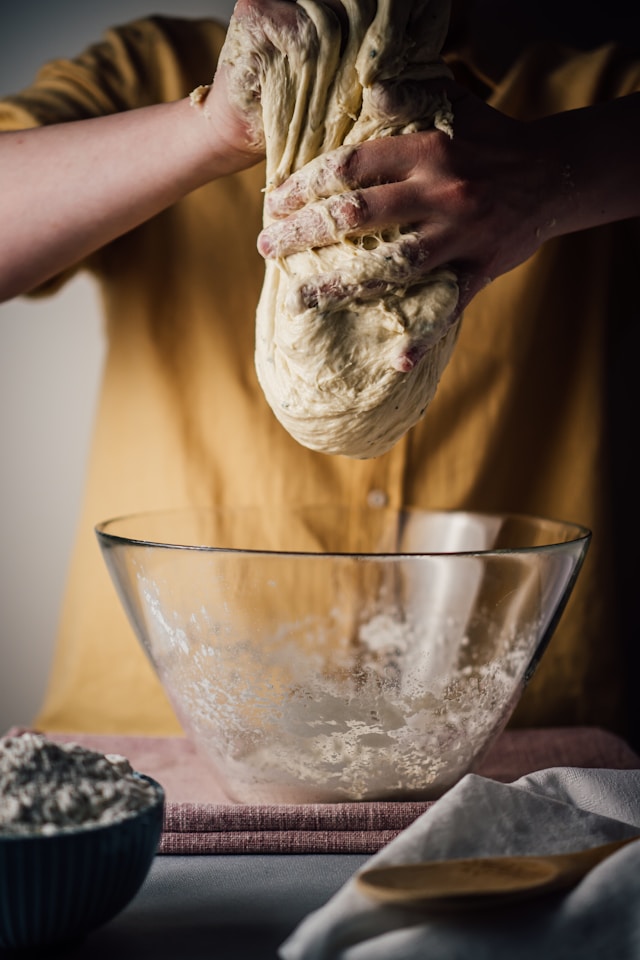
Focaccia Bianca e Rossa
Shared by Francesco Turrisi
Artist Notes:
Nowadays, “focaccia” is everywhere, on every exclusive restaurant’s menu, offered as a thick, fancy, and spongy high-hydration bread, usually topped with all sorts of things. But this doesn’t look at all like the focaccia I grew up eating in Italy. That one was thin, low hydration, crunchy, and drenched in olive oil. It came in grease-proof paper, and it was never eaten as bread at the dinner table. It was the perfect afternoon merenda—the middle-of-the-day snack needed to keep going until 8pm dinner. But it could also be a morning snack (or even breakfast in Liguria!), especially when I was out with my mother shopping, and we would stop at the panetteria (bakery), where we would buy bread and I could get a sneaky little piece of fresh focaccia on the go, and those were the best times! The bakers would always ask, “Bianca o rossa?” (White or red?) They often called it pizza blanca and pizza rossa, just to further confuse the ideas about what is pizza and what is focaccia. Pizza bianca was the classic oily focaccia; pizza rossa was the same but with a veil of tomato sauce on top. So here’s a little recipe to try to recreate those two focacce of my childhood!
This recipe is for two round pans with a 30cm (12in) diameter.
Ingredients:
Focaccia
- 500g (4 cups) 00 bread flour
- 275ml (9.2 oz) cold water
- 7.5g (0.2 oz) fresh brewer’s yeast (or 2.5g (0.8 oz) dried yeast)
- 12.5g (1 tbsp) fine sea salt
- 10g (2/3 tbsp) malt
- Polpa di pomodoro (pomodoro sauce) (optional)
Salamoia (brine)
For each focaccia pan you will need:
- 45ml (3tbsp) water
- ½ tsp sea salt
- Extra-virgin olive oil
Instructions:
- Dissolve the yeast and malt together into the water.
- Add the salt to the flour.
- Add the liquids to the flour and start kneading (by hand or in a stand mixer with bread hook)
- Work the dough for a few minutes until it comes together. Don’t over-knead it—the texture should still be quite rough
- Shape the dough into a ball and put it in an oiled container with a lid. Let it rest in the fridge for at least 20 hours.
- Brush baking pans generously with olive oil
- Divide the dough into two balls of equal weight and start flattening each ball with your hands.
- Use a rolling pin to flatten the dough thinner, into even discs roughly the same diameter of your pans.
- Transfer the dough discs into the pans and let rest uncovered for 90 minutes.
- Dust the discs very lightly with flour and press into them with your index, middle, and ring fingers to create the classic focaccia “holes”.
- Prepare the salamoia by dissolving the salt into lukewarm water.
- Pour the salamoia over the dough (it should almost be submerged) and distribute it equally.
- Pour olive oil over the focaccia holes until they are filled.
- At this stage, if you want to make focaccia rossa, spread a thin layer of polpa di pomodoro over one or both doughs.
- Let rest for another 90 minutes uncovered.
- Preheat oven to 230 C (450 F) degrees.
- Cook the focaccie on the bottom of the oven (touching the bottom) for 6-7 minutes, then finish them for another 2-3 minutes in the middle of the oven.
- Remove the focaccie from the pans and let cool on a rack.
- Brush with olive oil and serve.
Music Is Medicine: Harnessing the Arts for Wellness and Community
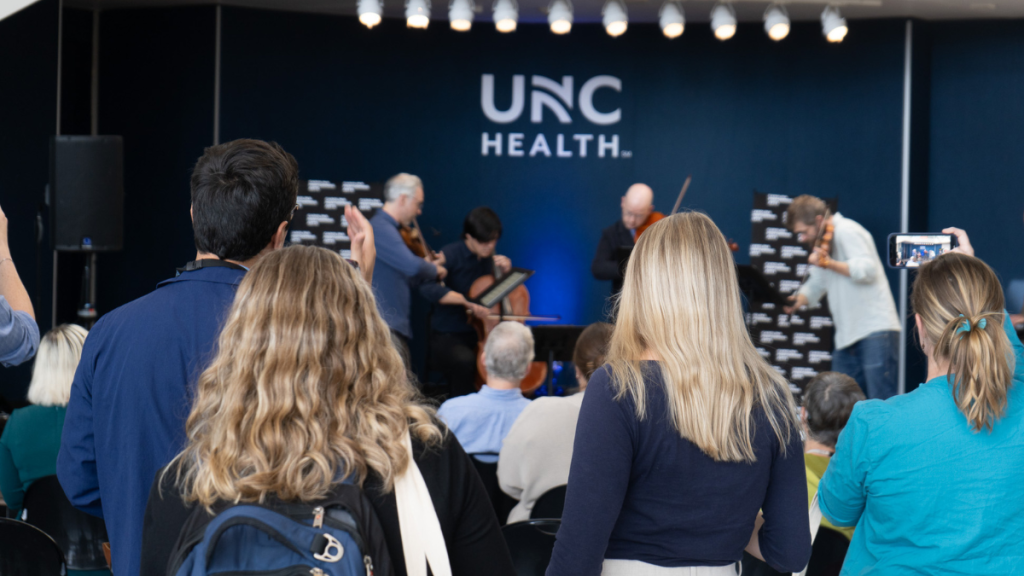
Earlier this month, the familiar rhythms of beeping machines at UNC Children’s Hospital gave way to a temporary new sound: the joyful tunes of uplifting children’s folk songs. In collaboration with CPA, Door to Door, and UNC Health, acclaimed string ensemble Brooklyn Rider delivered a delightful pop-up performance that broke through the routine, transforming the hospital lobby into a haven of music and joy for both hospital staff and patients.
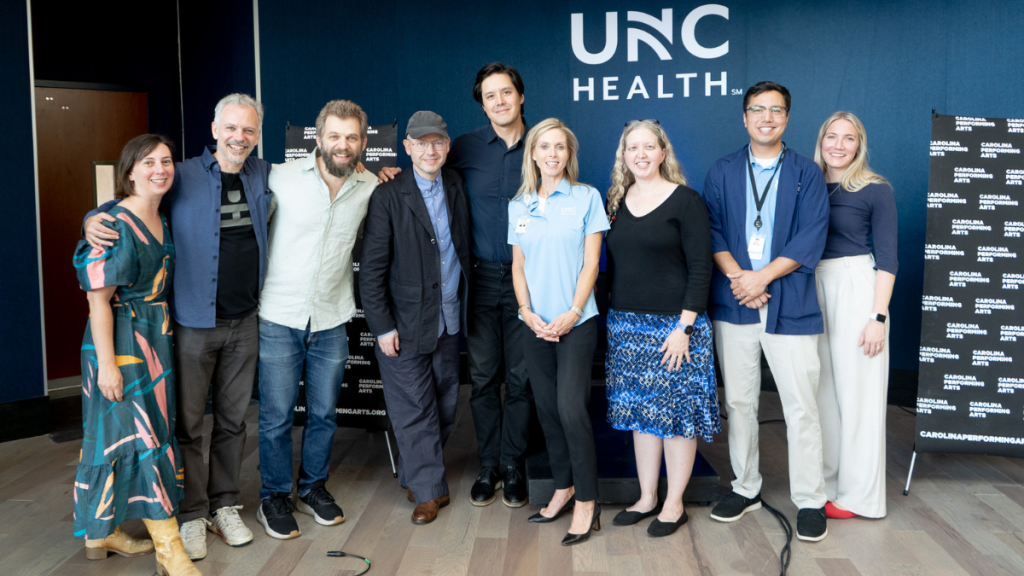
Several doctors and health professionals—including the President and Executive Director of UNC Hospitals—stopped by the performance, which also featured a special tribute to composer Philip Glass. RC, a doula who attended, said, “It was amazing. After a long, challenging labor, this moment of beauty really sustained me. Keep doing this!”
“Having music in the lobby is a way for people to have a respite from their busy day and truly dive into the music,” shared Amanda Graham, CPA’s Associate Director of Engagement. “We are interested in the power of arts to promote wellness and healing, and live music is a way to reinvest in the community.”
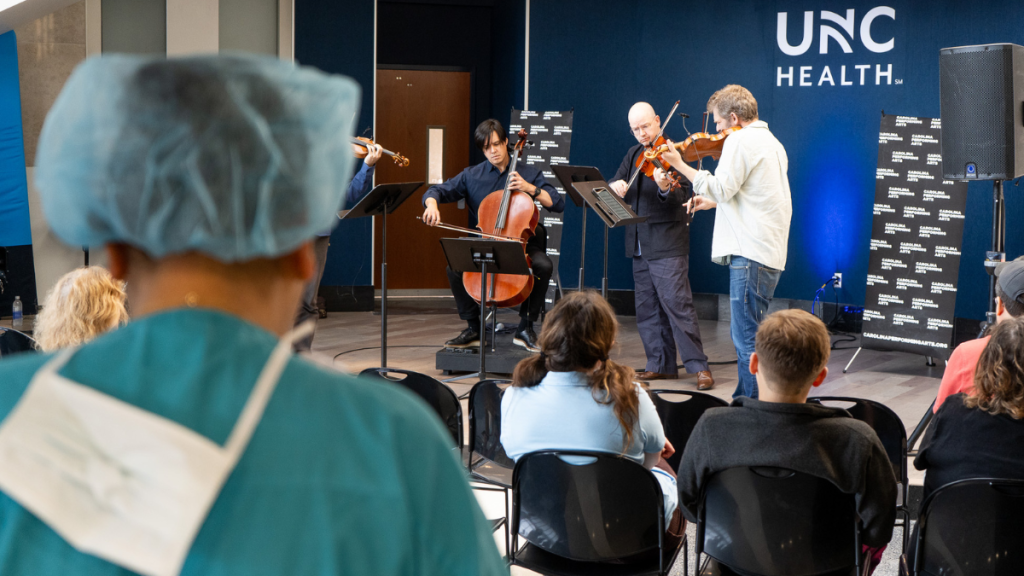
CPA has a long history of hosting free pop-up performances across the UNC-Chapel Hill campus, creating opportunities for exposure to the arts beyond traditional venues. Artists like Michelle Dorrance and Rhiannon Giddens have similarly captivated audiences with past pop-ups, demonstrating how the arts can spark curiosity and connection. For performers like Brooklyn Rider, these intimate performances offer an informal and direct way to engage with the community and experience the vibrancy of the UNC-Chapel Hill campus.
Brooklyn Rider is not only known for their captivating live performances but also for their innovative album, Healing Modes (2020). This album features Beethoven’s String Quartet Opus 132 alongside five new works from contemporary composers, each exploring the theme of healing. By bringing together a diverse range of historical and cultural contexts, Healing Modes exemplifies how music can serve as a bridge between art and medicine, enriching the experience of those who engage with it.
If you missed the pop-up and the two performances, don’t worry—Brooklyn Rider’s own Johnny Gandelsman, CPA’s first Curator-in-Residence and a recently-announced 2024 MacArthur Fellow, will return to present This is America. This series features new work that responds to the American experience during 2020 which spotlights Gandelsman and a lineup of incredible composers and musical collaborators.
The transformative power of music reminds us that even in the most clinical environments, moments of beauty and connection can have a profound impact on well-being. Here’s to more magical moments in the future!
As we strengthen our partnership with UNC Health and Door to Door, we eagerly anticipate more collaborations that connect CPA with organizations throughout the Triangle, fostering deeper engagement with artists. If you’re interested in collaborating with us, please reach out at CPAmarketing@unc.edu.
The Philadelphia Orchestra: Related Events
Dive deeper into the Orchestra’s long history of cultural exchange
As The Philadelphia Orchestra’s visit draws near, CPA wants to keep you updated on all the opportunities to learn about the various social, political, and historical contexts of their performance. Together with our campus community partners, we’ve assembled a range of public events for the week of this exciting visit. Read below to register and learn more.
PUBLIC DISCUSSIONS
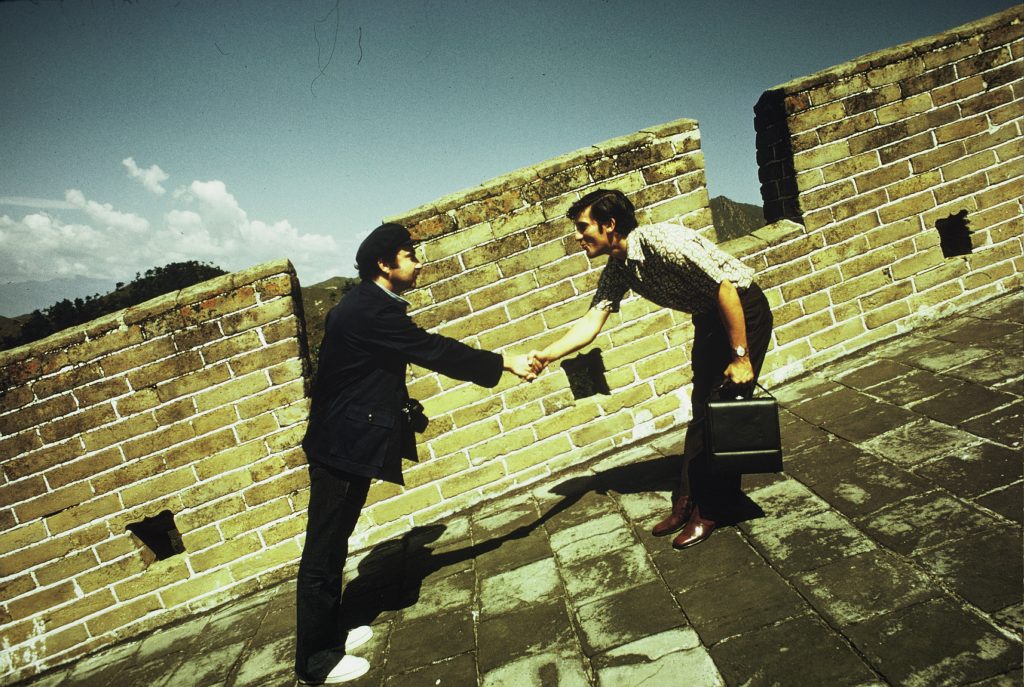
Two Weeks of Discovery
Philadelphia Orchestra Musicians Davyd Booth & Renard Edwards Recall 1973 China Tour
When: Tuesday, Sept. 19, 5–6 PM
Where: CURRENT Studio
In this public conversation, long-time Orchestra musicians Davyd Booth and Renard Edwards share their stories of visiting China with the Orchestra 50 years ago. Hosted by Douglas Shadle, Associate Professor of Musicology at Vanderbilt University and author of Orchestrating the Nation: The Nineteenth-Century American Symphonic Enterprise, this exchange will focus on oral history and the power of musical dialogue and friendship.
This event is free. Registration is required.
Program Notes Live: Florence Price
Douglas Shadle and Nicole Jordan Pre-Performance Conversation
When: Wednesday, Sept. 20, 6:30–7:15 PM
Where: Moeser Auditorium in Hill Hall
The luminous music of composer Florence B. Price (1887–1953), the first African American woman to earn international acclaim for her classical works, is taking the world by storm after decades of posthumous neglect. Under the direction of Music and Artistic Director Yannick Nézet-Séguin, the Philadelphia Orchestra has become a leader in Price advocacy, having earned a Grammy Award for its recording of her First and Third Symphonies. Orchestra Principal Librarian Nicole Jordan joins Price scholar Douglas Shadle of Vanderbilt University in a behind-the-scenes look at what it takes to breathe new life into great music of the past.
This event is free. Registration is required.
Program Notes Live: Hello Gold Mountain
Douglas Shadle and Matías Tarnopolsky Pre-Performance Conversation
When: Thursday, Sept. 21, 6:30–7:15 PM
Where: Moeser Auditorium in Hill Hall
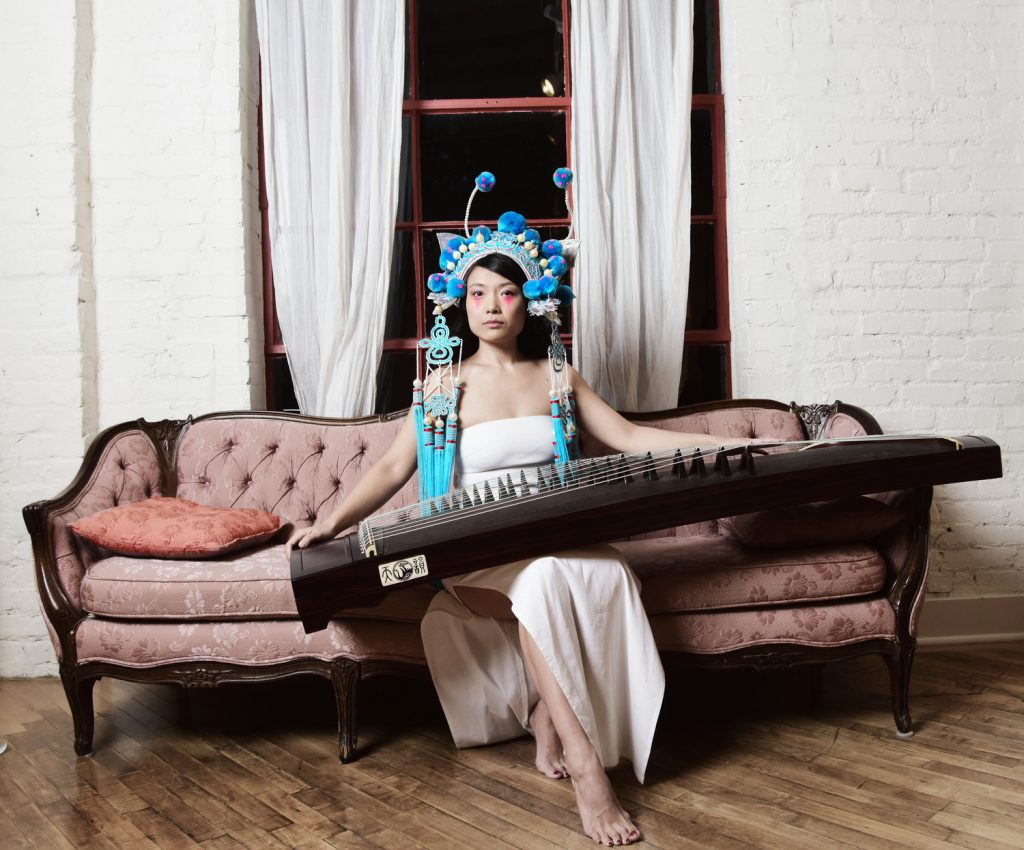
Set in the tumultuous context of war-torn China in the 1940s, composer Wu Fei’s Hello Gold Mountain captures the extraordinary experience of European Jewish refugees who fled to Shanghai during the Nazi era and then to California at the dawn of Communist rule. This exploration of unstable cultural convergence, a “requiem for lost possibilities,” offers an opportunity for profound reflection on identity, loss, and hope in times of global upheaval. Musicologist Douglas Shadle joins Philadelphia Orchestra and Kimmel Center, Inc., CEO Matías Tarnopolsky in conversation to explore the contemporary and historical significance of this work, and its relationship to intersecting Jewish and Chinese identities.
This event is free. Registration is required.
OPEN CLASSROOMS
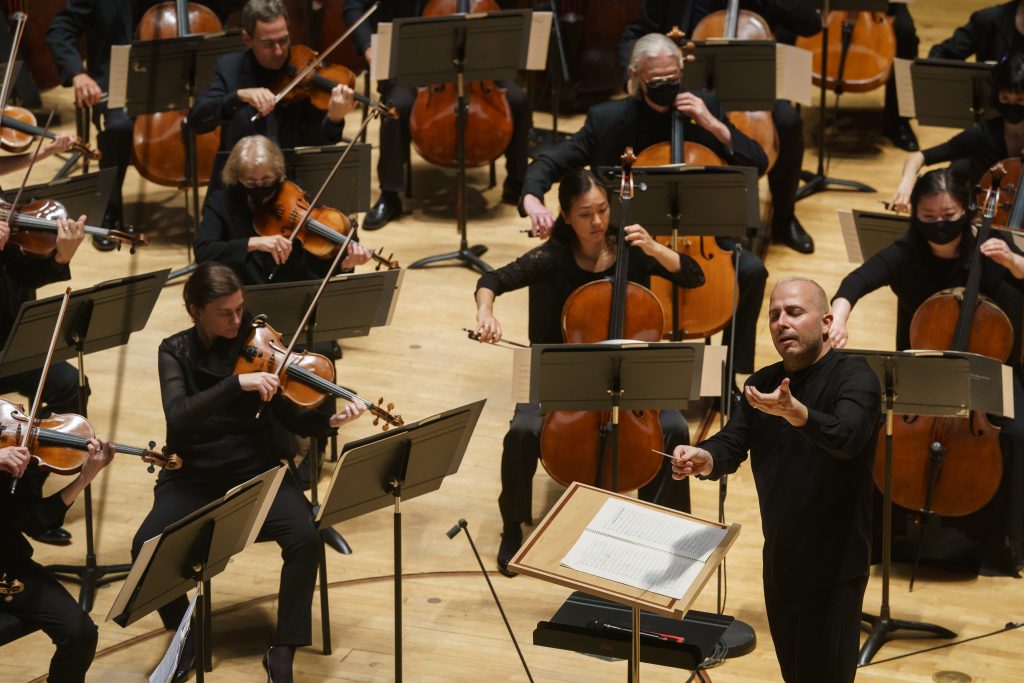
Hello Gold Mountain with Wu Fei
Hosted by Music 120: Foundations of Music
When: Wednesday, Sept. 20, 10:10–11:25 AM
Where: Hill Hall, Room 107
Hello Gold Mountain is an original composition by Wu Fei, featuring Wu Fei on guzheng and Shanir Ezra Blumenkranz (Silk Road Ensemble) on oud—the traditional Chinese and Jewish plucked string instruments, respectively. The work is inspired by real stories of Jewish refugees who fled to Shanghai from Europe before and during World War II and went on to build their lives in China.
In this “open classroom” presentation by Wu Fei, students and the public are invited to learn more about the history of Hello Gold Mountain and explore important questions: What musical possibilities were lost because the times did not allow neighbors from these different cultures to grow old together, sharing songs and stories? What artistic creations will be lost if Europe and the United States close the door to refugees and migrants from lands in chaos?
This event is free. Registration is required.
Orchestra Member Blair Bollinger, Brass
Hosted by Mike Kris
When: Wednesday, Sept. 20, 3–5 PM
Where: Moeser Auditorium in Hill Hall
This event is free. Registration is required.
Orchestra Member Yumi Kendall, Cello
Hosted by Brent Wissick
When: Wednesday, Sept. 20, 3–4 PM
Where: Hill Hall, Room 107
This event is free. Registration is required.
Orchestra Member Paul Arnold, Violin
Hosted by Nick DiEugenio
When: Wednesday, Sept. 20, 4–5 PM
Where: Hill Hall, Room 107
This event is free. Registration is required.
Orchestra Member Carol Jantsch, Tuba
Hosted by Mike Kris and Heidi Radtke
When: Thursday, Sept. 21, 3–4 PM
Where: Moeser Auditorium in Hill Hall
This event is free. Registration is required.
Women in Professional Music
Carol Jantsch and Heidi Radtke in Conversation
When: Thursday, Sept. 21, 4–5 PM
Where: Moeser Auditorium in Hill Hall
This event is free. Registration is required.
MORE INFORMATION
The Philadelphia Orchestra will perform at Memorial Hall on September 20 and 21. For more information on their upcoming visit, check out our event page.
Questions? Call us at 919.843.3333 or email us at carolinaperformingarts@unc.edu. Our box office is open 12–5 PM on weekdays. For more details about CPA ticketing policies, please visit our FAQ page.
Explore Omar: Related Events
Discover what’s happening around Chapel Hill in the lead-up to Omar.
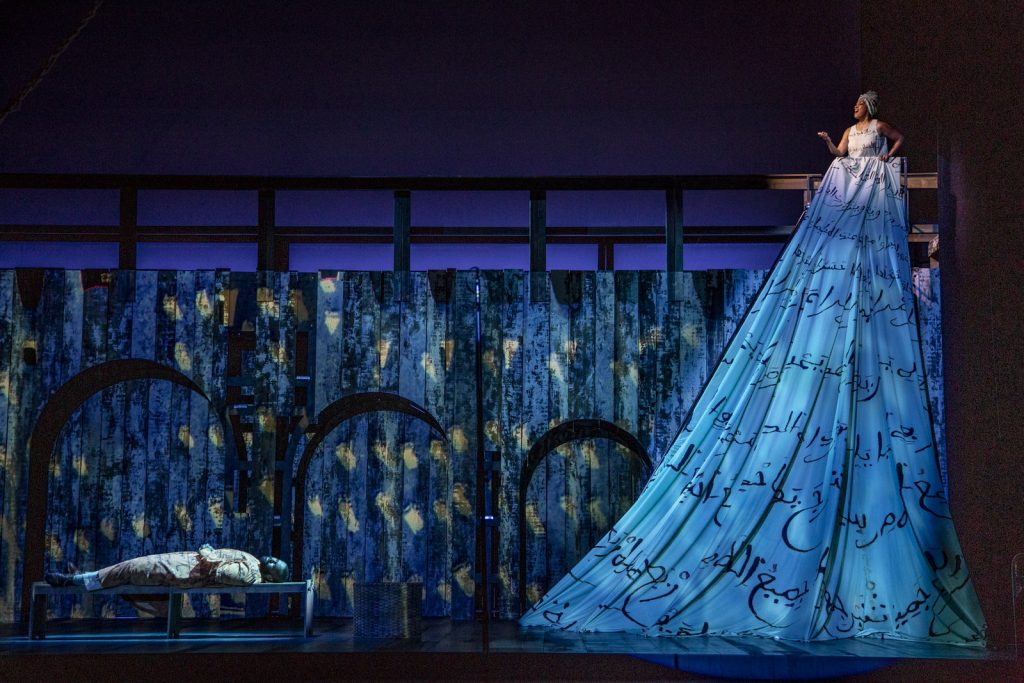
As the North Carolina premiere of Omar draws near, we want to keep you up-to-date on all the opportunities to learn more about this sweeping new work. Together with our partners, we’re proud to present a slate of programs that dive deep into the social, political, economic, and historical context of the performance. To learn what’s on the way, click here, or read the descriptions below.
CPA and MDC invite you to:
The State of the South, Omar ibn Said:
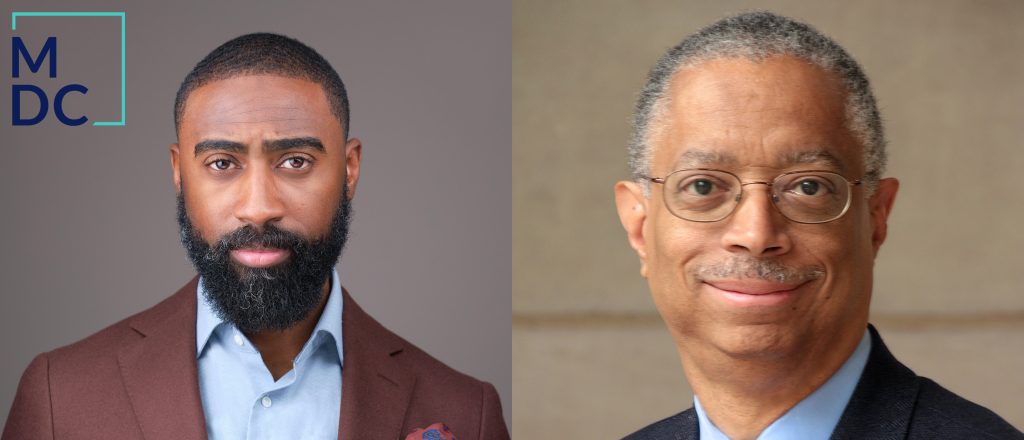
A Conversation Between Dr. Youssef Carter and Dr. William Spriggs
- When: Tuesday, Feb. 21, 5–6:30 PM
- Where: CURRENT Studio
Omar ibn Said’s story illuminates the historical and geographical relationships between Black Muslim religious empowerment, forced and chosen migration, and labor. As we think of the future of the South—as well as its present—understanding this history is essential to imagining economic systems rooted in equity.
Join us for a dialogue between Dr. Youssef Carter, an Assistant Professor of Religious Studies and the Kenan Rifai Fellow in Islamic Studies at UNC-Chapel Hill, and Dr. William Spriggs, the former Chair of the Department of Economics at Howard University and Chief Economist to the AFL-CIO. This dialogue will be moderated by MDC Senior Program Director Kerri Forrest. Together, we will explore and bear witness to the historical conditions of slavery faced by Ibn Said, while envisioning how we might realize systems that value humanity.
Registration is free! Click here to register.
CPA and the UNC Department of Music invite you to:
Performing & Imagining the American South “Open Classroom” on Omar
Rhiannon Giddens and Michael Abels in conversation with Dr. Naomi André
- When: Thursday, Feb. 23, 11:15 AM–12:15 PM
- Where: Moeser Auditorium in Hill Hall
The university community is welcome to join the students in Performing and Imagining the American South (IDST 121) for a conversation between Rhiannon Giddens, Michael Abels, and Dr. Naomi André on Omar, music, and the American South.
Dr. Naomi André is the David G. Frey Distinguished Professor of Music at UNC-Chapel Hill.
No registration required.

CPA, UNC Press, and the UNC African Studies Center invite you to:
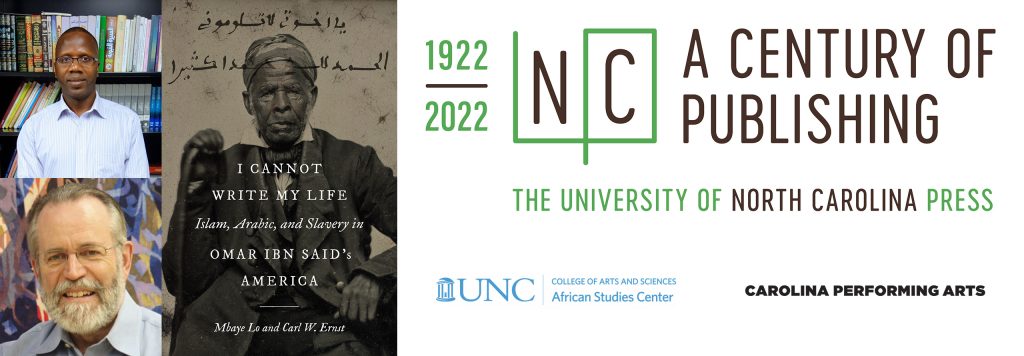
“What is the ‘Autobiogaphy’ of Omar ibn Said?” with Dr. Carl W. Ernst and Dr. Mbaye Lo
- When: Thursday, Feb. 23, 5:30–7 PM
- Where: FedEx Global Education Center, Nelson Mandela Auditorium
Omar ibn Said (1770-1863), a West African Muslim scholar, was sold into slavery in America, where he spent over half a century enslaved to a prominent North Carolina family. He left behind a small collection of documents in Arabic that remain poorly understood. This presentation is based on Dr. Ernst and Dr. Lo’s book, I Cannot Write My Life: Islam, Arabic, and Slavery in Omar ibn Said’s America, forthcoming from UNC Press in August 2023. Why, at the beginning of his 1831 “Autobiography,” did Ibn Said announce “I cannot write my life”? What is the significance of his quotations from Islamic theological and mystical texts, which have escaped notice until now? Ernst and Lo will address these questions and more. Join us to learn more about their major reassessment of this important witness to the presence of Islam and Arabic at the beginning of America’s history.
Moderated by Mark Simpson-Vos, the Editorial Director for UNC Press.
Mbaye Lo is an Associate Professor of the Practice of Asian and Middle Eastern Studies & International Comparative Studies at Duke University.
Carl W. Ernst is the William R. Kenan, Jr., Distinguished Professor Emeritus of Religious Studies at UNC-Chapel Hill.
Registration is free! Click here to register.
Up Close and Personal with Omar ibn Said Materials
Instruction Sessions in Wilson Special Collections Library
- Register for Session 1: Monday, Feb. 27, 9–10 AM
- Register for Session 2: Wednesday, Mar. 1, 3–4 PM
- Register for Session 3: Thursday, Mar. 2, 12–1 PM
Where: Wilson Library, Room 901
For folks who were able to see the Omar opera or are simply curious about its inspiration, we are offering three opportunities for our Carolina campus community to get up close and personal with documents and other materials related to Omar ibn Said. Guests who sign up online will have a chance to see the original 19th century artifacts featuring or written by Omar himself. In addition, guests will have the opportunity to speak with UNC reference librarians and learn even more ways to engage with Omar’s story and special collections at UNC Libraries.
For information and tickets to the performance, please visit our event page.
A Community in Motion
Local dancers reflect on involvement in the Bill T. Jones/Arnie Zane Company’s What Problem?

Photo: Taylor Barrett
The Bill T. Jones/Arnie Zane Company’s What Problem? is intensely concerned with the concept of community. Again and again, the production probes the possibilities and limitations of the concept, drawing from an array of sources, including Dr. Martin Luther King Jr.’s “I Have a Dream” speech and Herman Melville’s “Moby Dick.” It’s a gale-force reckoning with our current historical moment, replete with cutting literary commentary, rousing speeches, expert choreography, and insistent, pulsing beats. Dancers swirl at the heart of it all, both raucous and tentative, offering audiences a potent glimpse of the American polity in motion.
Achieving this effect requires a uniquely community-driven approach. Earlier this fall, when What Problem? came to Chapel Hill, such an approach was on full display. In advance of the performance dates, the company and Carolina Performing Arts put out a call for dancers from around the Research Triangle. The dozens who answered this call soon became integral parts of the production.
In the week leading up to the two performances, these dancers—known as the Community Movers—joined the Bill T. Jones/Arnie Zane Company for a series of rehearsals. To get the inside scoop on the Community Mover experience, we asked several dancers to share their thoughts on the rehearsals, as well as their reflections on the production. Here are their stories.
Note: Killian Manning’s testimonial was collected on the week of rehearsals, prior to the performances. The other three testimonials were collected after the performances occurred.
Killian Manning
“Thanks to Carolina Performing Arts and Amanda Graham, I began the adventure of a lifetime, one of those circle-of-life events that has this post-punk, pseudo-cynical grrrrl absolutely GIDDY. For this whole week, I’ve been rehearsing from 6–9 PM with the Bill T. Jones/Arnie Zane Company as a community member, culminating in performances on Friday and Saturday night at Memorial Hall. I’ve been following Bill’s amazing work since that mind-blowing first moment at the American Dance Festival in 1988 . . . which eventually led to my dissertation: ‘Performing Utopian Visions: Art(iculation) in the Age of AIDS’ (2004). Bill T.’s Still/Here is Chapter 3. My excitement through the entire process has been uncontainable, and my gratitude for the lessons learned is overflowing! Belonging to a community that shares my enthusiasm for his genius, sharing rehearsal and stage space with him and his wonderful dancers, being a part of this brilliant production . . . it just does not get any better.”
Christine Cabot
“Working with Bill T. Jones as a Community Mover was a rare and thrilling opportunity for me, thanks to a friend who forwarded the original email [invite]. My dance background was in classical ballet rather than modern dance; although I hung up my pointe shoes long ago, I have stayed in shape through dance aerobics, strength training, and yoga. Even in my 70s, I had no trouble keeping up with the other movers, mentally or physically.
Most of the movers were associated with local dance programs and therefore had friends within the group. I knew no one, but folks were friendly and casual. Shane and Jacoby were excellent coaches; Janet was very pleasant to work with; and Bill T. himself was a magical presence. It was a pleasure and an honor to work with this dance company. My friends who attended had nothing but praise for this highly original program. Other than some pulled muscles during the chaotic rock-throwing scene, I believe we all had a favorable and memorable experience and would do it again.”
Kathleen Fitzgerald
“I learned about this opportunity from my good friend who works at UNC. My favorite part was getting to know the dancers and the musicians. They are an amazing group of people, and it was wonderful to have a week with them. By the end of the week, we were speaking like friends, sharing stories of our lives together. I also loved being part of such a diverse group of community members. My thoughts on the production: it was such fun to be part of it. There was so much going on. The musicians were breathtaking. Hearing the words, “How does it feel to be a problem?” in song gave me goosebumps. It was astounding that in three days, we learned what we needed to do, and were ready for dress rehearsal and performances. Shane and Jacoby were wonderful teachers and coaches. They were patient and clear. They helped us take risks and be specific yet spontaneous and to explode with emotion and action when it was time. I learned that dancing is good for everyone, and through dance we can make messages come alive. I grew up in New York City, and when we were milling in a tight circle [as part of the performance], I recalled the tension of living in New York, and I also remembered the fear I felt when I saw police barricades. The way black people are treated in this country felt alive and visceral to me through the dance.”
Catching up with Rhiannon Giddens
An illuminating afternoon with the Southern Futures Artist-in-Residence
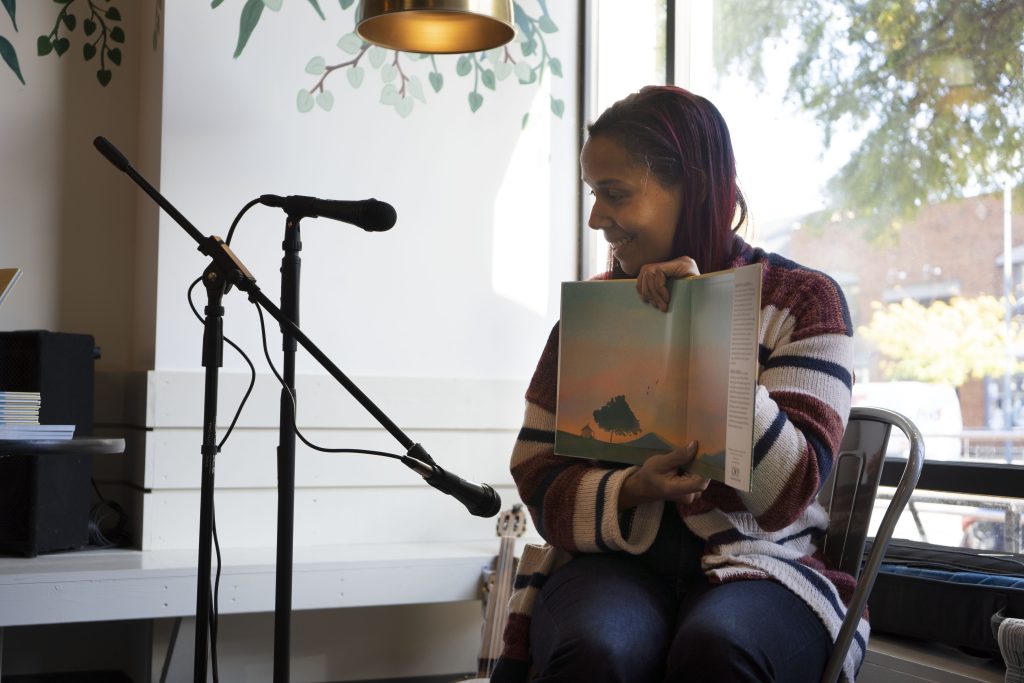
It’s been a busy year for Rhiannon Giddens. Since finishing her propulsive new opera, Omar — set to make its North Carolina debut this spring — the Southern Futures Artist-in-Residence hasn’t stopped moving. The past few months have been especially hectic, with trips to New York, Los Angeles and Dublin, as well as other, more far-flung locations. Between these events, as well as the recent launch of her new children’s book, “Build a House,” moments of rest must have been hard to come by.
Fortunately, last week’s visit to Chapel Hill gave Giddens a chance to regroup and reconnect with her North Carolina roots. Though the schedule was predictably packed, she had the chance to meet with community members and Carolina Performing Arts staff to discuss opportunities for collaboration. Early in the week, she also spent some time diving into the Louis Round Wilson Library’s robust archives in search of new material.
Giddens’ trip culminated on Wednesday, October 19, when she stopped by Epilogue Books to promote her new children’s book. Seated before the audience, a banjo at her side, she read from “Build a House,” an alternately harrowing and uplifting story of a Black family’s resilience in the face of sorrow and dispossession. Paired with painter Monica Mikai’s striking illustrations, Giddens’ words ably captured the attention of both the children and the adults in attendance. And, as a special treat, Giddens performed her song of the same name, composed for the 155th anniversary of Juneteenth in collaboration with world-renowned cellist Yo-Yo Ma.
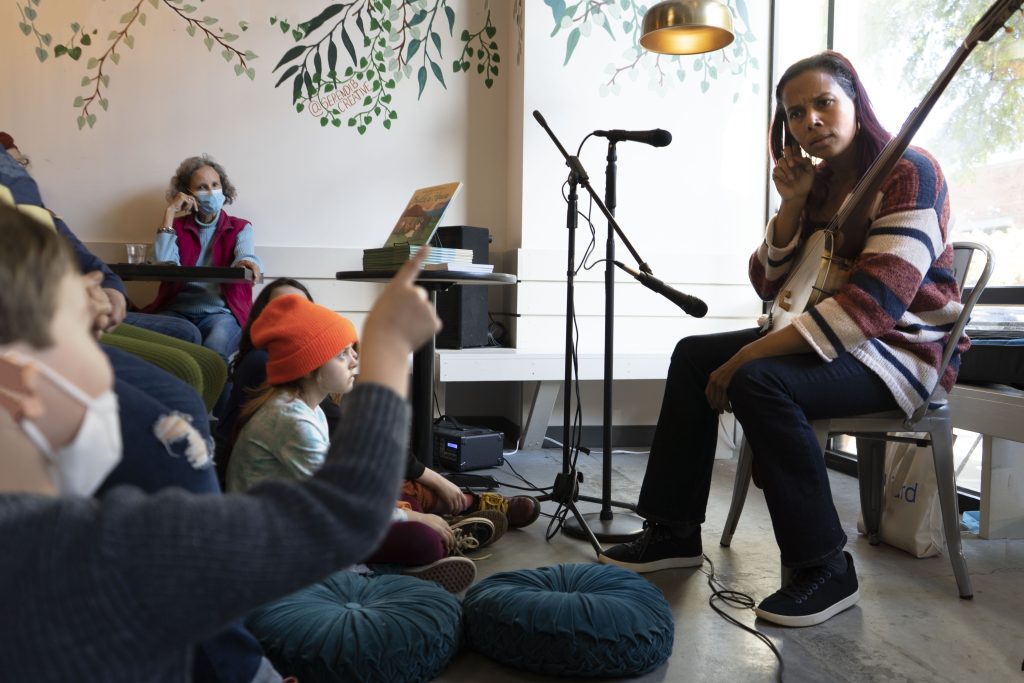
After the reading and performance, Giddens stuck around to sign books and take questions from the audience. During the Q&A she spoke on a wide range of topics, from “Build a House” to her long journey through the music world, often with refreshing honesty.
“I didn’t pick up any instruments until I was 23,” she told the audience, when asked about her musical development. “I was bad for a while. That was helpful, I think. It’s good to break yourself down to the basics, good to be willing to suck.”
As one might expect, the audience was especially keen to hear about the the making of Omar. Giddens was open and authoritative on the subject. Again and again, she underlined the collaborative nature of the project, and she discussed the work of Michael Abels, her co-composer, in glowing terms. Though she admitted that composing an opera for the first time was a significant challenge, she said Abels eased much of this challenge, helping her to stick to a more structured process. In addition, she spoke of her thrill at the idea that the form might be more familiar than she’d initially expected. Only, in Omar, she said, “the whole orchestra is a banjo.”
Toward the end of the Q&A, Giddens took a moment to discuss Omar ibn Said, the opera’s historical inspiration. She was quick to note that, though the opera contains many elements pulled from ibn Said’s 1831 autobiography, it takes a greater interest in the enslaved West African scholar’s internal, spiritual journey than it does in bare biographical facts. She stressed the need for further exploration of ibn Said’s whole story, given its cross-cultural connections. “This story should be told from multiple vantage points,” she said. “Omar is just me trying to find one way — my way — through the story.”
Here’s hoping more artists of Giddens’ caliber take up the challenge.
Intersectional Theatre: Presenting a Bilingual Prince Hamlet
Our residency with Why Not Theatre spotlights their groundbreaking approach
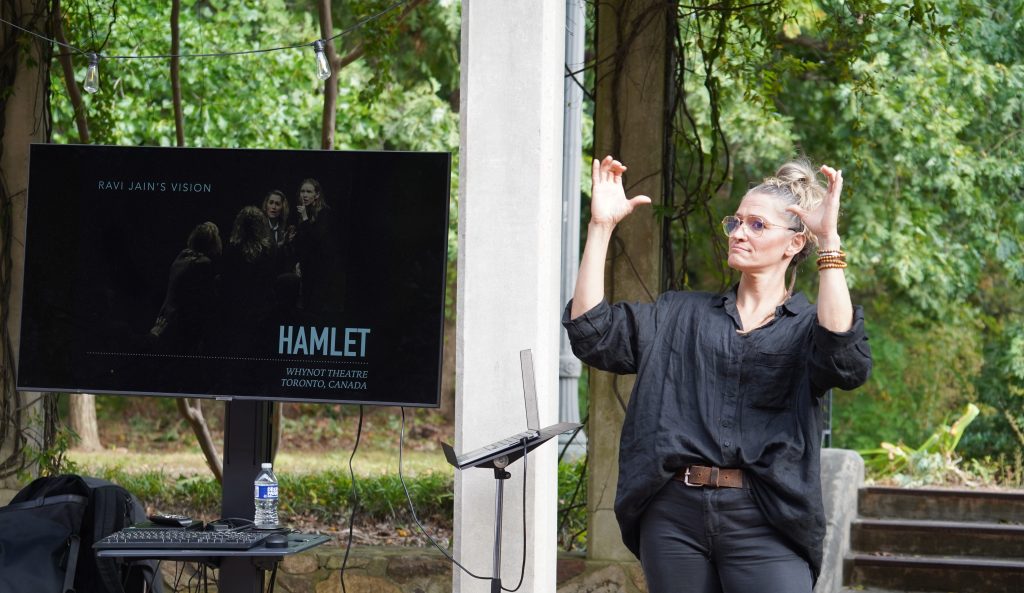
Photo by Taylor Barrett
Ahead of this Friday’s performance of Prince Hamlet, Why Not Theatre joined Carolina Performing Arts for a week-long residency. This included an in-depth discussion with actor and American Sign Language (ASL) translator Dawn Jani Birley about the company’s intersectional approach to William Shakespeare’s classic tragedy.
Throughout the conversation with CPA and PlayMakers Repertory Company staff, Birley highlighted her conscious rebellion against the idea that mere inclusion should serve as a true end goal. For Birley, inclusion feels too limited, as it fails to encompass the full range of her capabilities. By contrast, an intersectional approach allows Birley and the rest of the company to explore the multiple dimensions of Shakespeare’s characters through new lenses of language, gender and ethnicity. In doing so, Why Not Theatre challenges traditional notions of who exactly gets to tell these stories.
“I want to use my platform as an artist to break down the systemic barriers and open new avenues in the theatre. I hope work like this can be a part of that.”
Dawn Jani Birley
Director Ravi Jain’s retelling shows us the world through the eyes of Horatio, Hamlet’s best friend, as portrayed by Birley. Within this framework, we come to understand that Horatio’s deafness is just one of many aspects that inform his perception of that world. Combining English and ASL, the production offers a bold reimagining aimed at hearing and Deaf audiences alike.
This week’s residency also included a public pre-performance discussion with director Vivienne Benesch and actor Tia James of PlayMakers Repertory Company, which will present its own take on the Bard’s famous play in January 2023. The primary topic of discussion stemmed from a common thread: Both productions will feature a woman in the lead role. Cast members spoke about these challenges and opportunities with refreshing candor, offering a rare inside look at the performances to come.
Why Not Theatre’s Prince Hamlet will be presented at Memorial Hall this Friday, October 7. The PlayMakers Repertory Company’s performance of Hamlet will run from January 25 through February 12. CPA audiences can save 20% with promo code DENMARK.
Special Event: “Build a House” with Rhiannon Giddens
Join us at Epilogue Book Café on Wednesday, Oct. 19 at 4 PM for a very special book reading, signing, and Q&A with Build a House author, MacArthur Fellowship recipient, Grammy Award-winning singer-songwriter and Southern Futures Artist-in-Residence Rhiannon Giddens.
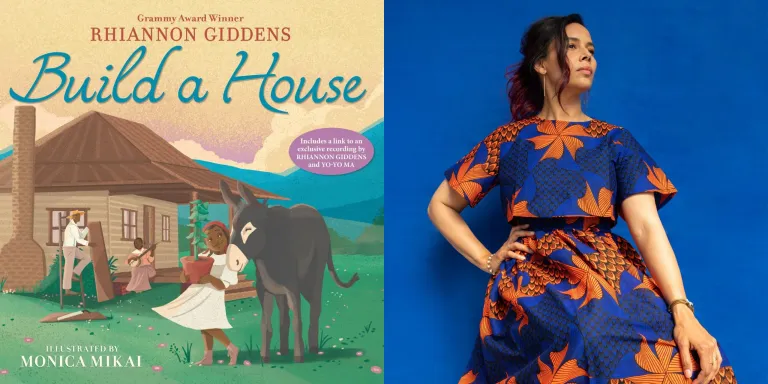
“Build a House”: A Sit Down and Signing with Author Rhiannon Giddens
YOU BROUGHT ME HERE TO BUILD YOUR HOUSE…
African Americans were forcibly enslaved and brought to this land to build houses they were not allowed to live in, tend to families who were not their own, and sow the seeds that fed a nation — while being left with only scraps themselves. They were not expected to thrive. But they did.
In her picture book debut from Candlewick Press, MacArthur Fellowship recipient, Grammy Award-winning singer-songwriter and Southern Futures Artist-in-Residence Rhiannon Giddens depicts a family’s resilience in the face of violence and sorrow. They are determined not just to survive, but also to tell their own story.
Based on the song “Build A House,” composed for the 155th anniversary of Juneteenth and performed with renowned cellist Yo-Yo Ma, Giddens’s stirring text is paired with moving illustrations by Monica Mikai. Build a House confronts the history of slavery in America by telling the story of a courageous people who would not be moved and the music that sustained them through untold challenges. Steeped in sorrow and joy, resilience and resolve, turmoil and transcendence, this dramatic debut offers a proud view of history and a vital message for readers of all ages: honor your heritage, express your truth, and let your voice soar, even — or perhaps especially — when your heart is heaviest.
Epilogue Book Café, Candlewick Press, and Carolina Performing Arts are thrilled to present this family event.
Rhiannon Giddens will be in Chapel Hill to continue her Southern Futures research. As an artist-in-residence at Carolina Performing Arts, Giddens is focused on celebrating the cultural contributions and the impact of Black and Indigenous populations that resided — and helped to build — Chapel Hill.
Carolina Performing Arts will present Giddens’ powerful new opera, Omar, Feb. 25-26, 2023. The spring season will be announced Nov. 1, 2022. Public on-sale for Omar and other spring events begins Nov. 15, 2022.
Alvin Ailey’s Revelations: An Experience Worth Repeating
A UNC-Chapel Hill graduate student shares her perspectives on this year’s performance — and her joy of discovery with each viewing of this modern classic.

By Kari Lindquist
Alvin Ailey® American Dance Theater, Carolina Performing Arts’ longest-running artistic partner, performed two separate programs at Memorial Hall on May 3 and 4 — but both featured the company’s classic closing piece, Revelations, an experience worth repeating. Repetition allows audiences to search for what’s new, what details stand out and how are they different than the last time.
Revelations was choreographed by Alvin Ailey and premiered in New York in 1960. He drew on African American cultural heritage and memory describing it as “sometimes sorrowful, sometimes jubilant, but always hopeful.” He used the idea of “blood memory,” that events are remembered in the body across generations, passed down by blood. Memory and repetition are central to the piece and it has been performed consistently across the world from the time of its premiere.
Before beginning as a graduate student at UNC-Chapel Hill, I taught a program at the Auditorium Theatre in Chicago with elementary and middle schoolers connected to the matinee performance by the Alvin Ailey® American Dance Theater. Some of my students saw the performance multiple times over the course of the years and I asked them each time, what surprised them? My students even came to expect to be surprised and thus brought to the performance both what they remembered and the craving to notice something new.
There’s so much to enjoy in Revelations, from the smallest gesture to the skill and athleticism of the dancers. My favorite part is in the opening movement of “I’ve Been Buked” — the hand flick on unaccentuated beat in the music that is added last to the iconic formation associated with Ailey and Revelations. I remember this gesture and anticipate it, but the moment when it happens still surprises me.
This time, I was surprised by the rapidly shaking hand gesture used in Cry, right before Revelations, and that I remembered in “Fix Me, Jesus,” danced beautifully by Jacqueline Green and Yannick Lebrun. I was thinking that with how quickly this small gesture moves, it must be hard for the dancers to control it exactly and that each time must be spontaneous and slightly different. Even if only by one or two shakes or with how quickly they happen, the gesture would be difficult to recreate the same way each time even on tempo with the music. I found myself trying out the gesture by trying out the shake in my own hand as I walked across campus after the performance and thinking that not only is it different across the differently choreographed pieces, it must vary across dancers and unique performances. Although the recorded music used for Revelations is the same each time, the element of live performance lends itself to the spontaneous, even in the often-repeated choreography and the way the rhythm is conveyed.
From the choreography and the music to the individual expressions of the dancers in the company, Revelations makes repeated viewing valuable.
When Ailey talked about Revelations, he even mentioned the music even more than the choreography. The music of Revelations, curated by Ailey, comprised of traditional spirituals. The texture of the vocal lines resembles the way the choreography allows individual dancers’ strengths to stand out and blend into the ensemble. Many of the tracks have sparse instrumentation highlighting the choral sound with limited percussive instruments. Additionally, the recording of Revelations includes Billy Porter as one of the singers, now recognizable from his role on the series Pose among his other accomplishments.
A favorite number of my students, “Wade in the Water” brings out props at a midpoint in the performance. The song was used as a way to give advice during the Underground Railroad that in order to not be tracked, those escaping enslavement could walk through water. The song seemed innocuous to those unaware of its secret meaning. This reflects the “double-consciousness” of Black Americans that W.E.B. DuBois has described; the layers of meaning draw on a rich cultural heritage and lend themselves to new understanding in their repetition.
Whether you’ve never seen Alvin Ailey® American Dance Theater or if you’ve been to every performance, there is more to enjoy with each repeated viewing of Revelations. From the choreography and the music to the individual expressions of the dancers in the company, Revelations makes repeated viewing valuable. Each performance can reveal a new aspect of this treasured piece if you let it surprise you.
Kari Lindquist is a graduate student in musicology at the University of North Carolina at Chapel Hill’s Department of Music.
CPA looks forward to the return of Alvin Ailey® American Dance Theater in the 23/24 season.
Outdoor Festival Showcases Local Bands

Chapel Hill Community Arts & Culture and Carolina Performing Arts (CPA) are excited to collaborate on Tracks Local Music Fest, a free outdoor concert in downtown Chapel Hill later this month.
On Saturday, May 21 from 3-7 p.m., five diverse acts from the Tracks Music Library collection will perform back-to-back as part of Tracks Music Fest, taking place outside at CPA’s CURRENT ArtSpace + Studio. The lineup spans a range of genres — from pop to hip hop to punk rock — mirroring the mix of sounds that make up the Triangle’s music scene. Each act will play a 30-minute set with small break in between:
3:00 p.m. — Kicking off the event is Anne-Claire, NC-born and Carrboro-based singer and songwriter. “I write music about experiences I’ve had growing up in the Triangle,” says Anne-Claire in her artist bio. AC is known for elegant vocals both on and off the stage — as a teacher of singing and songwriting for adults and kids alike.
3:50 p.m. — Americana band Dissimilar South takes the stage with sounds rooted in country and folk genres while experimenting with synthesizers, electric guitars, and drum kits. Expect tight harmonies and lyrics that explore “the bittersweet nature of relationships and queerness with honesty and whit.”
4:40 p.m. — Transition to the dance realm with Treee City, the electronic music project of Durham-based DJ and producer Patrick Phelps-McKeown. Drawing inspiration from field recordings, pop radio, vintage technology, and 90’s rave nostalgia, Treee City’s sound is unique and an essential part of the Triangle’s electronic music scene.
5:30 p.m. — Rapper, producer and songwriter Austin Royale turns up with a full band to explore experimental sounds of hip hop, rock, and beyond. Austin continues to recreate himself and has been an ongoing influence in the local music scene for almost a decade.
6:20 p.m. — The event closes out with punk rock duo, BANGZZ, hailed for their “loud and fast songs with in your face feminist themes.” Guitarist, vocalist and songwriter, Erika Libero, is also the co-founder of the local Chapel Hill music festival Manifest.
Each slated act appears on Tracks Music Library, a free local music streaming platform from Community Arts & Culture and Chapel Hill Public Library. With over 100 albums from Triangle-based artists, Tracks aims to help new audiences discover new music and for local musicians to reach new listeners.
Tracks Music Fest will be held at CPA’s CURRENT ArtSpace + Studio, located in Carolina Square and created to connect campus and community via the arts. “Carolina Performing Arts is thrilled to partner with Community Arts & Culture to host this celebration of North Carolina music at CURRENT ArtSpace + Studio, right in the heart of downtown,” says Alison Friedman, CPA’s James and Susan Moeser Executive and Artistic Director. “It’s an important moment to collaborate to launch artists, local businesses, and our communities on the road to recovery from the last two years.”
Limited seating is available so bringing a chair or blanket is recommended. Beer and ice cream will be available for purchase. Additional food can be purchased at local and nearby restaurants. To learn more about the event, including parking and transportation options, visit chapelhillarts.org/tracksfest. To learn more about Tracks Music Library, visit tracksmusiclibrary.org.
Media inquiries: Contact Melissa Bartoletta at mbartoletta@chapelhillarts.org.
Southern Hip Hop Primer Playlist

Hip Hop South Festival co-curator and CPA staff member Christopher Massenburg (a.k.a. Dasan Ahanu) offers a Southern hip hop playlist to help audiences prepare for the April 22–23 events.
“Southern Futures aims to imagine a more just and inclusive vision of the American South by imagining the future, focusing on humble listening and community engagement, and bringing storytelling and art to the foreground. With that aim in mind, I selected Southern rap tracks that I felt brought social commentary to the forefront, spoke beautifully of material conditions, offered compelling messages and were a vibe. I selected songs from acts that represent different parts of the South. There are some big hits and some songs that are loved but not chart topping. They all deserve a listen. The South still saying all the things!”
Read more about the scholarship and inspiration behind this new event: Hip Hop South Festival Q&A with Christopher Massenburg
Hip Hop South Festival Q&A with Christopher Massenburg
Hip Hop South Festival co-curator and CPA staff member Christopher Massenburg (a.k.a. Dasan Ahanu) shares the scholarship and inspiration behind this new event — and what audiences can expect.

What inspired you to partner with Dr. Regina Bradley on the Hip Hop South Festival?
Regina and I met while we were both Fellows at Harvard University’s Hip Hop Archive and Research Institute. Regina is a brilliant Southern hip hop scholar. When I suggested the idea of the festival, I knew I wanted to work with Regina. We’ve had so many great conversations about the culture and the South. I knew she would have the perfect perspective on the festival.
How would you describe your co-curation process? How does your Fellowship at Harvard — and your continued scholarship at UNC-Chapel Hill and elsewhere — inform it?
The great thing about working with Regina is that we are friends. Talking about the festival is really us dreaming about a dope Southern hip hop experience that we would want to enjoy. The curation is experience first. Then we think about the logistics that can provide that experience.
We are both products of the culture. We grew up in it and it is a part of how we see the world, how we move. We both seek to bring the South, the Black South, the Hip Hop South into our work whenever we can. It is our experience with that ongoing integration in spaces like our fellowship, our teaching, our writing, and our participation in various projects that we brought to the curation of the festival.
How did you determine which artists to feature? What makes their work particularly noteworthy or exemplary of Southern hip hop culture?
We started with a large list of possibilities. We wanted to make sure there was a range of artists on that list. The South isn’t a monolith. The same is true for hip hop in the South. The artists are different and distinct.
The other thing to consider is geography. There is a Southern aesthetic, but that aesthetic also varies from area to area. What is happening musically in Memphis is different from Atlanta, New Orleans and North Carolina. It makes for a really beautiful puzzle to work with. Of course, we also wanted to make sure North Carolina was represented in this festival.
How do the festival artists and academics tie to CPA’s Southern Futures initiative?
Southern Futures aims to imagine a more just and inclusive vision of the American South. I believe that to do so it is imperative to consider the role of hip hop in the story of the South. Hip hop is a revolutionary culture that pushes back at rigid conventions. It offers folks an outlet to speak about the material conditions impacting their life. It also allows for a celebration of their South own their terms.
Southern Futures’ mission is to examine the past of the UNC-Chapel Hill campus and greater community; and imagine the future, focusing on humble listening and community engagement, bringing storytelling and art to the foreground. Storytelling is a big part of Southern hip hop music. There are rich and beautiful stories to be told and Southern rap artists tell them in compelling fashion.
Southern hip hop scholarship is still making sure the academy knows the South got something to say. It was critical to hold space within the festival for Southern scholars to be able to connect and network. Fighting for room within the academy for your scholarship can feel daunting, but knowing that you are part of a cadre of scholars pushing the Hip Hop South to the forefront can be encouraging and affirming. We wanted folks to be able to know what work was being done, share experiences and resources, and build new relationships. An initiative like Southern Futures provides an opportunity to center Southern art and scholarship.
How would you describe Southern hip hop culture to those who may be less familiar with it? What makes it distinctly different from the broader hip hop culture and canon?
I can’t describe Southern hip hop to someone. I can let them know that it is its own flavor of wonderful. I can assure them that they need to experience it. Commercial representation doesn’t do it justice. The festival is a chance for people to really immerse themselves in the culture in a Southern way. Like many things in the South, you have a better understanding when you can experience in context and it its moment. So folks just need to come on down and have some fun with us.
What can audiences expect to see and hear during the festival?
What audiences can expect to see and hear is joy. Throughout the festival there will be excitement, anticipation and joy. There is joy when we gather. There is joy when we celebrate. When we can get together in a space held for us we can be us openly. That is joy.
So folks should come ready to have a ball, hang out with good folks, and experience some Southern joy.
What do you hope audiences will take away from the Hip Hop South Festival experience?
I want folks to have enjoyed it so much they can’t wait to see what we do next. I want folks to know that this event is exactly what is needed and is a great addition to the music landscape in North Carolina, in the South.
Get ready for the Hip Hop South Festival with Chris’ playlist: Southern Hip Hop Primer Playlist
Announcing the Hip Hop South Festival at Carolina Performing Arts

Carolina Performing Arts at the University of North Carolina at Chapel Hill is excited to announce the Hip Hop South Festival, a two-day event from April 22–23, 2022 that celebrates the impact of hip hop across the South. Co-curated by Harvard Nasir Jones Hip Hop Fellows Christopher Massenburg (also known as Dasan Ahanu) and Regina Bradley, the festival will feature headlining performances by hip hop heavyweights and local artists, as well as academic gatherings, late-night beat and dance battles, visual art and more.
The Hip Hop South Festival is part of CPA’s Southern Futures initiative, which features arts experiences co-created with local communities and focuses on racial equity, social justice and the American South. As a co-curator and CPA staff member, Christopher Massenburg looks forward to exploring hip hop culture with audiences.
“The Hip Hop South Festival creates space for deeper exploration and appreciation of hip hop’s geographical influence by focusing on the development and impact of the culture across the South.”
HIP HOP South festival co-curator christopher massenburg
The festival kicks off Friday, April 22 with a main show at Cat’s Cradle, featuring North Carolina favorites Carolina Waves, Shirlette Ammons, and Rapsody — followed by Turn It Loose, Volume 3 — a late-night B-boy jam at CURRENT ArtSpace + Studio, hosted by the Raleigh Rockers, and featuring breakdancing demonstrations and competitions with dance crews from across the region.
The excitement continues Saturday, April 23 with a main show at Memorial Hall, featuring some of the South’s finest hip hop artists — Radio Rehab, Sa-Roc, and Big Boi — followed by a late-night beat battle at CURRENT ArtSpace + Studio, hosted by The Underground Collective, and featuring local luminaries The Soul Council, who will provide beat demonstrations and judging.
Festivalgoers will also enjoy a visual arts experience throughout the two days. “Dirty South Scribes,” an exhibit by Regina Bradley at CURRENT ArtSpace + Studio, honors the groundbreaking writers who spotlight Southern rap’s significance.
See the full festival schedule.
Tickets are on sale now and include single-day and two-day pass options; a limited number of UNC-Chapel Hill student tickets are available.
Learn more about what to expect when you visit our venues — including ticketing, parking, and health and safety protocols — in our Event FAQ.
About Carolina Performing Arts
The mission of Carolina Performing Arts is to spark curiosity, inspiring all members of its community to discover and more fully engage with the world. The 21/22 season programming at Carolina Performing Arts features Southern Futures at Carolina Performing Arts, designed to facilitate co-creative arts experiences that produce diverse and nuanced narratives about racial equity, social justice, and the American South and create spaces for inclusive dialogue and learning.