
5 Quick Facts with BLACK LODGE Composer David T. Little
Written by Lauren Wingenroth
BLACK LODGE, which comes to Memorial Hall on October 30th, is hard to categorize. It’s a live performance and a film. It’s an opera that at times feels more like a rock concert. It’s a surrealist exploration of grief, art, and redemption based on a disturbing true story—and a thrilling pre-Halloween experience for Chapel Hill audiences.
“If you just trust the piece and go with it, it’ll reveal itself in exciting and hopefully meaningful ways,” says composer David T. Little. “My goal is always for people to have a profound experience and respond emotionally to things, and it’s my hope that this piece will do that for them—and at the same time it’s also a really fun rock show.”
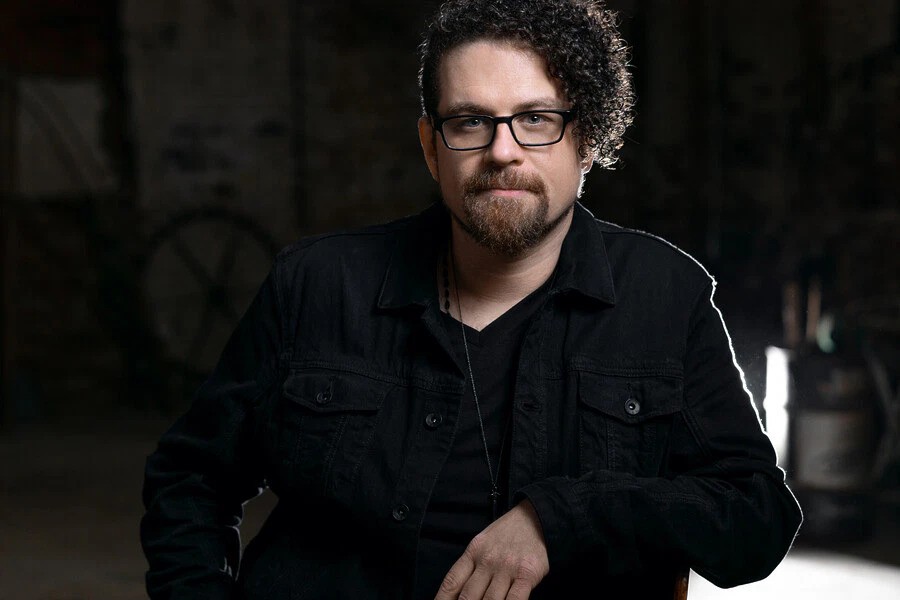
Ahead, Little shares five quick facts to prep audiences for the multidisciplinary, genre-bending, and extraordinary world of BLACK LODGE was inspired by three key artists.
Audiences will see and hear many influences within Black Lodge, but three artists were most formative in the piece’s making: surrealist filmmaker David Lynch (of Twin Peaks and films like Lost Highway); French theater director Antonin Artaud, who conceptualized the Theatre of Cruelty; and Beat Generation writer William S. Burroughs, whose troubled life inspired the opera’s central character. Early in the creative process, Little began to see the parallels between the three artists. “I connected Artaud’s theatrical theories to Lynch’s aesthetic to the writings of Burroughs,” he says. “There was a pursuit of a sort of spiritual transcendence through dark things.”
BLACK LODGE took over ten years to create.
The initial idea for BLACK LODGE was born in 2011, when producer Beth Morrison pitched the idea of a serialized Twin Peaks opera to Little. From there, Little and librettist Anne Waldman explored many iterations of what would become BLACK LODGE, like an opera performed by three singers who would represent Lynch, Burroughs, and Artaud, and an installation-style opera where audiences would wander through a warehouse space and encounter different characters. As plans for the installation piece began to emerge, the pandemic hit, so the creative team pivoted to make a BLACK LODGE film. The current version of the piece premiered in 2022, and features Timur and the Dime Museum and the Isaura String Quartet performing the music live in conjunction with the film. The pre-show experience, BARDO, “brings back this idea of a space where the audience explores on their own,” says Little. “We wanted the world of BLACK LODGE to spill out into this installation space.”
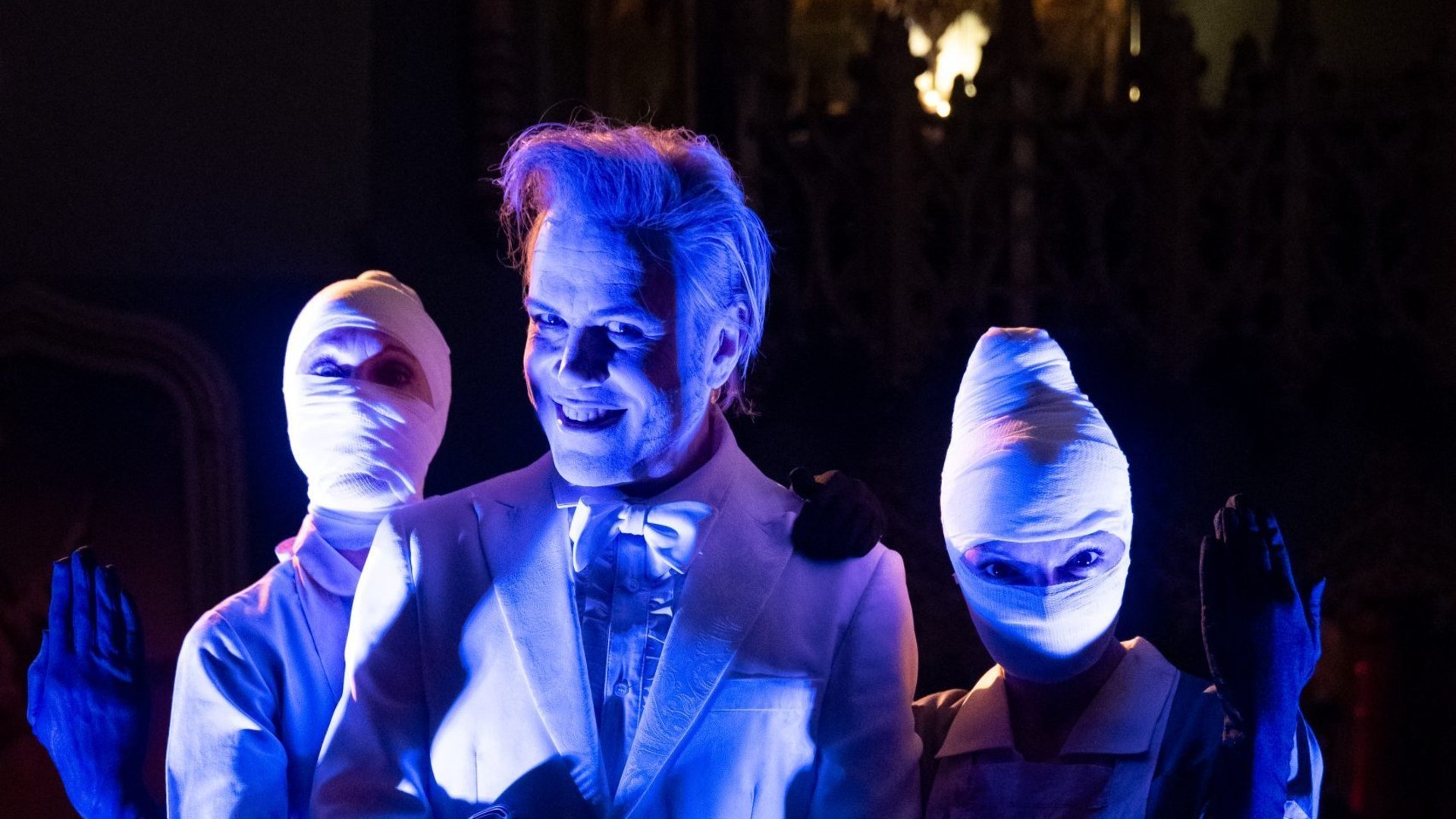
BLACK LODGE was created specifically for Timur.
Early in the making of BLACK LODGE, Little saw a performance by Timur Bekbosunov, and decided that he should be the show’s sole singer. “He is unbelievable,” says Little. “He’s got this glam punk opera thing, and he’s such a showman, but then his voice is just insane. He can do absolutely anything.” Writing for such a versatile and virtuosic singer allowed Little to “explore the extremes” of the music. “Part of my job as a composer is to create works that make performers look amazing,” he says. “Because I loved his instrument so much and I liked him so much as a person, I wanted to write something that really made him shine.”
The process of making BLACK LODGE (not just its subject matter) was inspired by Burroughs.
Burroughs popularized the “cut-up technique,” which involves cutting up text and rearranging it. “He would say that if you break the language, it tells you the future,” says Little. Burroughs used this technique for his own writing, and also to discover the hidden meaning of a text, and Little and Waldman used it to develop both the score and the libretto of BLACK LODGE. “I like the idea that if you break music, it reveals its secrets,” Little says. “So I tried to break the audio using software to release whatever the sound is inside the sound.” He also made a cut-up version of Waldman’s original libretto. “That unlocked a lot,” he says.
BARDO has its own musical language.
Little also composed the score for BARDO (which he released as an album called Dark Hymnal). “It takes audio from BLACK LODGE and stretches it out to an unrecognizable scale,” says Little. “The slowness of that audio transforms all of the events in the original to be completely different.” He gives the example of the “mouth noises” a singer makes when singing into a microphone that are usually undetectable. “When they’re stretched out, they become like tectonic plates shifting,” he says. For Little, creating the music for BARDO was a way of going deeper into the world of BLACK LODGE after living in it for ten years. “It broke it wide open again,” he says.
BLACK LODGE and BARDO come to Memorial Hall on Friday, October 30. BARDO opens at 7 p.m., and BLACK LODGE begins at 9 p.m. A single ticket includes both experiences.