Where Worlds Meet: Inside EcoTones, A Memory Project
In the field of ecology, the term “ecotone” refers to an area of transition where two ecosystems meet, creating a unique, biologically diverse environment.
It’s a fascinating ecological concept, and a profound metaphor. What grows where two people, or two communities, encounter one another? What does the space between ourselves and our environments hold? What is possible at the edges?
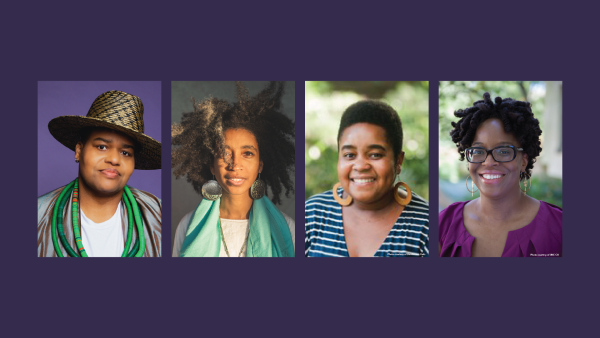
Ecotones are everywhere. And in Toshi Reagon’s EcoTones, A Memory Project, a collaboration with UNC faculty members Danielle Spurlock and Danielle Purifoy and Durham-based writer and scholar Alexis Pauline Gumbs premiering on November 7, they are the source material for a performance that is an ecotone in itself, where music, storytelling, research, and history meet.

Many years in the making, EcoTones, A Memory Project emerges from a long history between Carolina Performing Arts and Reagon, who has developed ideas and roots in the Triangle community through three different residencies beginning in 2017. CPA audiences know her distinctive, deeply expressive voice from many previous appearances, including her collaboration with tap dancer Michelle Dorrance, The Blues Project, and her Octavia Butler-inspired opera, Parable of the Sower.
Reagon’s relationships with her collaborators also run deep. She has worked with Spurlock, an Associate Professor in City and Regional Planning and Purifoy, an Assistant Professor in Geography, since an early CPA residency researching Parable of the Sower. “Octavia wrote books that were really connected to the idea of transformation,” says Reagon. “A big part of my journey to the opera was working with people who in their fields actually knew the solutions to problems that were happening.” And with Gumbs, author of many books including Undrowned: Black Feminist Lessons from Marine Mammals, Reagon has collaborated extensively. “There is a multi-lifetime commitment working itself out through the way my creativity and Toshi Reagon’s ideas belong together,” says Gumbs.
Below, learn more about their collaboration, what we can learn from ecotones, and the generative relationship between artmaking and academic research.
What is an ecotone, and why does it matter?
Ecotones “are where different worlds or systems meet,” says Purifoy, who researches ecotones as a framework for understanding human communities as part of her work focused on the intersection of Black studies and political ecology. “They’re really interesting spaces to think about new life forms emerging, or encounters of life forms.”
Purifoy originally pitched the idea of exploring ecotones to Reagon. “We’re thinking of it as a metaphor for the intersections of the different worlds that each of us inhabit through our lineages,” Purifoy says.
Spurlock recognized the concept of an ecotone in her own research, which is focused on environmental gentrification and the relationships between land use, the environment, human behavior and structural inequality. “When Danielle Purifoy was first talking about this idea, I recognized it in my work as these transitional places between land uses, between jurisdictions that shift between the built environment to these undeveloped areas,” she says. “I was intrigued by that idea, and also by this broader interpretation that was going to allow us to talk about transitions through generational archival work.”
And for Gumbs, the idea of an ecotone resonated with her family history. “I am a shoreline person. My ancestors are people who have lived at shorelines in West Africa, in the Caribbean, on the Eastern Shore of Maryland and in Shinnecock Long Island and Sandy Ground Staten Island,” she says. “I believe that makes me a person of the edges or the interface. I identify as a meeting place for generations and forms of love, so I have to live inside myself in such a way that opens my heart to the possibility of encounter again and again.”
The resulting work encapsulates the ways in which ecotones exist in the work of all four collaborators, and in their family histories. “We’re telling the stories of our ancestors as it relates to place and the ecological,” says Purifoy. “The ecotonal of it all is the convergence of those worlds onstage—the echoes of ideas and experiences, and the overlaps across the stories.”
Telling these stories of ancestry, environment, and place is crucial to understanding ourselves, in this moment. “All these stories are important so that you don’t feel like you’re tethered to nothing,” says Reagon. “You’re actually tethered to a path, and understanding the journey to who you are now can be empowering.”
The making of EcoTones, A Memory Project
Reagon and her collaborators developed EcoTones, A Memory Project through research, conversations, workshops, and more recently, through a series of collaborative concerts, where they explored the resonance of songs and stories. Some of these took place at CPA, and others at NorthStar Church of the Arts in Durham, which has been a longtime creative home and community for Reagon and her collaborators, and one that Reagon values for being an ecotone in itself, existing at the boundary between being a church and a performing arts space. (This is a particularly fruitful intersection for Reagon, who describes her work as a “singing congregation” that brings people together through music and community.)
Purifoy, who says she was drawn to storytelling and creative writing long before she became an academic, says this process “really brought me back into my own creative process, which was something I thought I needed to abandon” as a scholar, she says. “I’ve been transformed by it.”
For Spurlock, it was freeing to explore her research through a creative practice, and to participate in a storytelling tradition that she sees as “an extension of what my community partners do,” she says. “They are doing the work of trying to reshape policy, whether it’s housing, transportation, food security, or public safety, and they’re talking about their families, their communities, and the stories that are told about themselves and their place.”
In this way, the fact that EcoTones, A Memory Project places faculty research and community artists on the same stage is a living example of what a university can do, and a way of communicating scholarly ideas in a way that is both more immediate and more accessible. “So much academic work exists behind a paywall,” says Spurlock. “This is our tradition, particularly within the Black community, of providing context through that oral storytelling. For me, it was a way to connect with those roots that I’m already a part of.”
“Creative methods have a possibility of reaching us on a different level than some of the more scholarly work can do,” agrees Purifoy. “In your body, you’re going to take it in differently than if I just told you about a set of facts on a page. Before your rational brain can take in some of these things, your imagination can.”
The reverberations of EcoTones
The work of EcoTones, A Memory Project has echoes in both the wider community in which it takes place and in the scholarship and practices of the collaborators who made it.
Spurlock, for instance, says that the experience of making this work “sparked a desire to think about other archival work within planning,” she says. So far, that’s looked like an interest in looking at archives related to the 1939-1940 New York World’s Fair and what it meant for Black populations.
Reagon hopes that the piece generates a sense of intimacy and responsibility for audience members in relationship to their environments. “You, too, can have an intimate relationship with the environment that you’re in,” she says. “So why don’t you take responsibility for that? You’re the handoff from the ancestor before you, and one day you’re going to hand off to someone else.”
EcoTones, A Memory Project will also reverberate throughout campus through several additional events. On November 1, there will be a community storytelling event where special guests and community members can share stories around their connections to their community or family history. And just before EcoTones, A Memory Project, audiences can experience a pre-show libation ceremony and procession with public historian and seventh-generation Black Chapel Hillian Danita Mason-Hogans and conservation social scientist Shorna Allred honoring generations of laborers at UNC-Chapel Hill. (Learn more and register for both events here.)
“I hope everybody comes out because it’s going to be a really cool and interactive evening,” says Reagon. “We’re going to be asking the audience to participate and sing through these stories that everybody has in their lives. Everyone can align their experiences with the environment they grew up in, and trace their experience through the water, the trees, the air, and the community.”