
Johnny Gandelsman on 20 Years with Carolina Performing Arts, Collaboration, and Curating ‘This Is America’
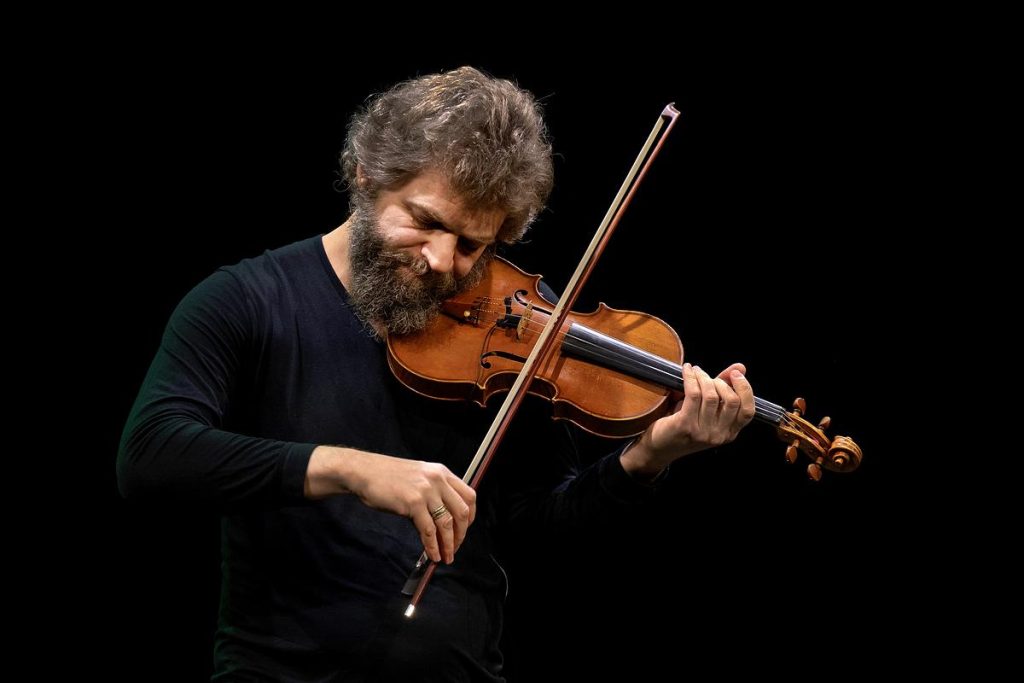
(Johnny Andrews/UNC-Chapel Hill)
This is the first in a three-part conversation with Johnny Gandelsman.
by Lauren Wingenroth
Setting the stage
When the Carolina Performing Arts staff was planning for the organization’s 20th anniversary this season, they took a look back at the past twenty years. “We reflected on the long-term partnerships we’ve had with artists over the years, to see what we’ve done and what’s really important to us,” says Amy Russell, CPA’s senior director of artistic and production. “We added up the visits by artists who have held a lot of meaning for us, and who’ve collaborated with us in the most compelling ways.”
One artist stood out: The acclaimed violinist Johnny Gandelsman, who took the title of being CPA’s most-frequent guest over the past twenty years. It’s not just the volume of Gandelsman’s visits to CPA that’s remarkable, but the diversity of them. He’s come many times with his string quartet, Brooklyn Rider, as well as with the Yo-Yo Ma-founded Silkroad Ensemble. He’s worked at CPA with collaborators from Memphis Jookin dancer Lil Buck to banjo player Abigail Washburn to tap dancer Michelle Dorrance. And of course, he’s come as a soloist, including with his performance of Bach’s Cello Suites in 2020.
“I love that I’ve gotten to be myself in slightly different situations,” he says. “Every project brings out something different, and that’s a nice feeling.”
Over the years, he’s also brought nearly as much to the Carolina community offstage as he has onstage—from working with students in the music department to teaching business school students about collaboration to playing for patients at the hospital.
For this 20th anniversary season, Gandelsman has returned to Chapel Hill in a new role, as CPA’s first-ever curator-in-residence. As curator, he’s programmed a five-part series featuring music and collaborators from his This is America anthology, which includes 22 commissions from 22 distinct composers, each responding to their experience of the early days of the COVID pandemic.
Offstage, he’s been spending time with Dr. Flavio Frohlich and his Carolina Center for Neurostimulation looking at music’s effect on the brain. “The healing power of music is something people have studied and believed in for centuries, from the Greeks to Beethoven,” Gandelsman said at a recent event, where attendees could observe the brain waves of one of Dr. Frohlich’s team members as she listened to Gandelsman play Bach. “I find the work that they’re doing so inspiring.”
Q&A with Johnny Gandelsman
We spoke to Gandelsman in the midst of his This is America series (two performances remain of the five-part CPA series) about why CPA is such a special place for him, his favorite memories in Chapel Hill, and why he loves collaborating.
When you first started coming to CPA, what struck you about it? What made it feel like a place you’d want to come back to?
I’ve been coming to CPA since 2007, but I think it was maybe a year later that I got invited to come to campus with Brooklyn Rider and a band called Two Foot Yard. We were invited to create a piece, and that was just so unusual, because we were very young, and not an established string quartet at all. The fact that CPA put this trust in us and in the process and valued that as much as the end result—maybe even more—was really cool. From that point on, it was like, this place is special. And now, it’s kind of funny because Brooklyn Rider is also celebrating our 20th anniversary. So, our little organization has been growing parallel to CPA. Now it’s been 20 years of going to all sorts of different presenters in this country and other countries, and still, what CPA does is incredibly unusual, and I think that’s why artists love coming to Chapel Hill.
What have been some of your favorite offstage memories with CPA over the years?
As a musician, we’re often on the road, going to places we haven’t been to before. You fly in, you take a train, you play a show, you leave, and you just repeat and repeat and repeat. When we come to CPA, we know we’re going to be there for a few days, and that just immediately means there’s a deeper engagement. This past time, we got to go to the Children’s Hospital and play there, and that felt really nice. I remember when we were in town with Lil Buck and Cristina Pato, the awesome Galician bagpiper, we did an event outside on campus. That was really funny, because the bagpipes are unbelievably loud. Nobody knew what was going to happen, but once they heard the bagpipes, the students just started gathering. That very impromptu moment of connection to the arts was kind of magical. You can see on students’ faces that there’s still a sense of wonder, and moments like that stick with you for a long time.
You’ve collaborated with so many different artists at CPA. What’s your philosophy around collaboration?
There’s always something unexpected that will happen. Going into something, it’s hard to know what you’re putting yourself into, so there’s a sense of discovery. There’s sometimes a sense of fear, because you’re walking into something unknown. When you get through to the other side of that fear or hesitation, you get to know not just the art of your collaborator—whether it’s dance, or a different genre of music that you’re not familiar with—but also the person, because you’re interacting with something that person cares about super deeply, so they’re usually very generous about sharing their knowledge. It’s a really good exercise in saying yes, in not rejecting something, but trying to figure out, what is the best way to achieve this thing?
Is there something about CPA that makes it an especially generative space for those collaborations?
The depth of CPA’s commitment to commissioning is really unusual. When you commission a new piece, that’s already putting an amazing amount of trust into the people who are going to create the work, because you don’t know what the end result will be. Very often, there’s nothing to share—there’s no video, no photos. It’s just, I’m thinking about this thing. The fact that that then resonates; the fact that CPA can take that and say, Oh yeah, I see value in this, and we’re going to put support behind you to make sure that you get from the seed of an idea to actually making it work. Artists often doubt themselves and we are very used to hearing no or not hearing anything at all. Most of the time, that’s what we hear. So when somebody says yes—and not just yes, but yes, and we will give you all this other stuff to make sure that you’re really fulfilling your vision—that’s priceless, and it’s rare.
Tell me about your latest engagement project with CPA: working with Dr. Flavio Frohlich and his Carolina Center for Neurostimulation on music and the brain.
It was really cool to play a little bit and then see the waves and how a person responds. Of course, I can’t read it—I don’t know what it means—but it’s really cool to see what happens to a person when they’re experiencing music. I know how it feels when I’m in a good space if I’m playing. I also know how it feels when it’s bad. If the brain mapping went not on the person listening, but on the person who was performing and could track when you’re nervous or when you’re calm, that would be interesting to see.


