
Johnny Gandelsman on Music, Memory, and the Making of ‘This is America’
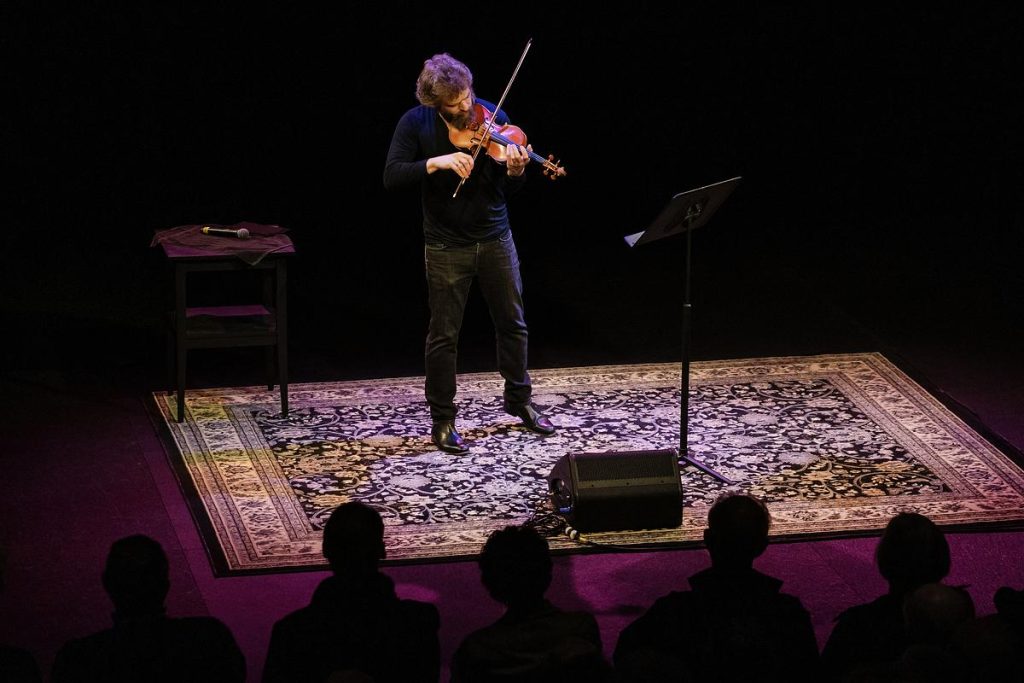
(Johnny Andrews/UNC-Chapel Hill)
This is the second in a three-part conversation with Johnny Gandelsman.
by Lauren Wingenroth
The Anthology
In 2020, when the acclaimed violinist Johnny Gandelsman was commissioning music for what would become This is America, he gave the 22 composers he chose a seemingly straightforward task: To write a piece for solo violin that somehow responded to the moment in time they were living in.
The diversity of the anthology of music that resulted from those instructions, and the breadth of feelings and experiences it captured, speak to both Gandelsman’s gift as a curator and the rich diversity of American contemporary classical music. This year, in his role as Carolina Performing Arts’ first-ever curator-in-residence, Gandelsman has brought many of those complex and riveting pieces to Chapel Hill, through a series of five concerts—many of which have featured the composers themselves as guest musicians.
Though over four years have passed since the highly specific moment in time that inspired This is America, the anthology’s works remain prescient, illuminating and urgent.
“I invite you to stop listening to pundits, extend your ears, open up your imagination, and trust the music to guide you into a challenging, complicated and thrilling sound world,” Gandelsman wrote in the introduction to the anthology.
Q&A with Johnny Gandelsman
We spoke with Gandelsman ahead of this month’s final two performances in the This is America series, asking about his inspiration for the anthology, what he’s learned from performing these works, and why they continue to resonate today.
Tell me about the impetus for This is America. I know it came out of 2020—what was it about that moment that made you want to do a project like this?
It was a moment of serious disconnection. My family and I spent about six months of the pandemic away from our home in Brooklyn in a remote part of New Hampshire, so we were literally physically disconnected from our communities and our friends. And, of course, as performers, there were no shows. There was no way to be together. At the same time, all these things were happening—COVID and police brutality and the fires in California and the election. The discourse was a lot to experience while being in lockdown, away from people. So I was just trying to figure out what to do, because usually, in moments of crisis, artists think about ways to address things. I thought, what if I could commission new works from composers who are in need of work, and ask them to somehow reflect on that period of time? I didn’t know where it was going to go. I didn’t know how many pieces were going to be commissioned. I didn’t know it was going to end up being an anthology.
How did you go about choosing the composers you wanted to commission? What were you looking for?
I keep a lot of long lists of people I’ve been curious about or wanted to work with, and then, of course, friends who I love who I also wanted to commission. I did want it to be representative of this country, so people with different backgrounds, different ages, different musical styles and genres. I guess what I discovered is that there’s so much more out there. Since then, the list just exploded, which is exciting. I’m thinking about ways to start addressing that.
Given that the music really speaks to that moment in 2020, what do you think it has to say about this new moment we’re living in now, in 2025?
While it may feel like we’ve moved on, the truth is that many of the challenges we faced in 2020 remain unresolved. But I think the music resonates with audiences because it is directly tied to a period of time which is pretty fresh, and everyone has their own very unique and yet also universal memories of what was happening then. In a concert setting, when I’m presenting a selection of the works, I don’t think everybody loves everything, because the styles are very different, but I do think that people somehow connect to what the composer was experiencing. Each of these works is a small window into the person’s thought process, experiences, heart and soul. With what’s happening now, it’s just proof that there’s so much more work to be done. We can’t stop. Everything is so acute and so many communities that are part of this country and are also represented in this anthology are being targeted. So I don’t know what we can do, except represent those voices and lift them up somehow.
How has your own personal relationship to the music deepened over the past several years that you’ve been playing it?
When I was first receiving these works, in many cases, I was asked to do things that I was either unfamiliar with or uncomfortable with. So I definitely had that moment of fear before getting to the point where I could perform the works in front of audiences. That was a big learning experience for me. Now I feel like a proud Grandpa. I love these works. I love that they exist. Recently I saw an Instagram post of a violinist in San Francisco performing one of these works, and I just felt like a proud grandparent. They’re out in the world doing their thing, and I’m really happy about that.
As This is America continues to find new audiences, Gandelsman’s vision—to capture a country’s complexities through music—feels more vital than ever.


